Showing posts with label Mangaphobia. Show all posts

Tuesday, 22 October 2013

Mangaphobia 05: Fullmetal Alchemist

A thank you, first, to everyone who's given me recommendations for Mangaphobia so far. This episode is the one where I've truly stepped outside my comfort zone - watching something I knew absolutely nothing about beforehand - and I couldn't possibly be writing it without you. Of everything suggested to me, this show has been by far the most common and popular, so it seems the logical place to dive in. Wish me luck!


There is a moment in Akira (the seminal anime movie of, well, ever) where a girl almost gets raped. I actually really like Akira - it's the most consistent anime, in terms of tone, quality, message, and every other respect, that I've seen - and I respect it greatly for playing that scene as traumatic rather than titillating (ahem). But then, after the heroes save her, one of them laughs and, for a moment, he bounces on the spot with horrible jerky animation and these little white mushrooms of air float out of his mouth. That moment is so out of place - so at odds with everything else in the film and especially that scene - that it fundamentally broke Akira for me. When I think of that film, bouncy mushroom guy is the first thing that comes to mind, and it takes a few seconds to remember all the great parts instead.

I'm sure there's a name for this - the horrible thing in anime and manga where they slap giant floating "vein" lines over someone's head, or little wiggly rivers coming out of their eyes - but I don't know what that name is. Lets go with "sweatdropping", in honour of the most common offender.
This crap doesn't even work in absurd comedy like Azumanga Daioh, so when it appears in something as serious and adult as Akira it actually makes my teeth hurt. I don't understand why anyone does this - it's not funny and it destroys the tone and drama of whatever else is going on. Just draw some actual human emotions on their faces, damnit!

Enter Fullmetal Alchemist.
This is a show absolutely littered with sweatdropping of the most gratuitous and inappropriate kind. In just the first ten minutes we go from scenes of an incredibly horrific childhood accident to suddenly having those same children turn into ridiculous chibis. Characters die in legitimately upsetting ways, and then others will do the silly waterfall-tears thing about it. In the middle of dramatic fights and vital plot revelations, people's faces will suddenly turn into emoticons. I praised Cowboy Bebop for having a varied tone that shifts gently between drama and comedy, but the tone here swerves so often and so violently that it almost gave me a hilarious anime nosebleed.

Yet, counter to all common sense and previous experience, Fullmetal Alchemist works.

This confused me for ages, but I think I've finally figured out how it works and why. The problem with the sweatdropping in Akira, and in pretty much everything else, is that it's jarringly at odds with the tone (and art-style) of the rest of the film. There's a consistent look and feel to everything that gets suddenly shattered by something totally different. But the reason it feels so inconsistent is not purely because the sweatdropping happens - it's because it only happens once. In the entire film, the breath-mushrooms are the only time we see anything like this, so it sticks out like a sore thumb.
In Fullmetal Alchemist, where it's happening all the time, these sudden, violent gear-changes don't clash with the tone because they sort of are the tone. The show is consistent in its inconsistency, if that makes any kind of sense.

Don't get me wrong - the sweatdropping is still by far the worst thing about the show. For the first few episodes the tonal dissonance is almost too much to cope with - alternately dark as hell and childishly stupid - and even after you settle into it there are still many moments that don't work. The most serious character in the show suddenly announces, in a scene with much sweatdropping and even a nosebleed, that his ultimate plan is to force all women to wear tiny skirts - and, because we'd never even seen him smile before, I honestly couldn't tell if he was joking or not.
On the whole, though, the sweatdropping works. It's not funny (because it's never funny) and I personally don't think it adds anything - but it doesn't cause any problems either, just becoming a (very weird) part of the show's texture.

And what a show it is! Fullmetal Alchemist is the tale of the Elric brothers - two teenage alchemists who get embroiled in war, politics and ungodly supernatural horror.
Alchemy in the show is magic treated as a science, or possibly vice versa; the manipulation of matter, at the chemical level, using arcane circles. With it, alchemists can do pretty much anything - except, as the Elrics gruesomely discover, the manipulation of human beings. The brothers' forbidden meddling leaves Edward, the eldest, missing two limbs and Alphonse, the youngest, a bodiless soul fused to an empty suit of armour.

Already, these are two of the most interesting characters I've ever seen in an anime. As what is essentially a robot, Al is invincible, immortal and impossibly strong; yet, as the younger brother, he's the more naive and emotionally vulnerable. Likewise, as the eldest, Ed is incredibly protective of his brother and feels responsible for him, despite Al being three times his size and made of metal. They're inseparable and entirely devoted to one-another, and the back-to-front sibling dynamic between them is wonderful.

Together, the Elrics set out to find the one source of alchemical energy great enough to restore their bodies: the fabled Philosopher's Stone (or "Sorcerer’s Stone" to American Harry Potter fans). Also hunting the stone are a sinister group of superhuman creatures, the scarred assassin of a persecuted religion, the entire fascist military state, and more besides.
Each of these groups comes with their own characters and their own plots, and they're all engaging and deep. As the separate stories intertwine with the brothers' the show keeps us guessing - allies become villains and villains become allies and we, like the Elrics, are never sure what's true or who to trust.

While all these colliding stories do sometimes get quite convoluted, they thankfully never get confusing. When there are things we don't understand it's only because the characters don't understand them either, never because they're explained badly or obtusely withheld from us. After suffering through Evangelion for the last couple of months this direct approach is, frankly, quite a relief.

In fact, thinking about it, Fullmetal Alchemist is almost the anti-Evangelion in a lot of ways. There's a lot of thematic overlap between the two - they both grapple with the same ideas - but where Eva loudly draws attention to its themes and then does nothing with then, Alchemist lets them simmer under the surface quietly making a specific point. Both shows are fundamentally about what it means to be human and the nature of the soul - yet only one of them bothers to explore what a soul actually is and whether or not it matters.
Both shows also deal with dead mothers, absent fathers, child soldiers, loss, obsession, ambition, sins of the past, death, resurrection, science, religion; and, in every single case, Fullmetal Alchemist is less overt about these ideas, yet does much more with them in a fraction of the time.

The strongest example of this is that, in just two episodes, it explores existentialism better than Evangelion's entire series of Shinji talking to himself. During a couple of mid-series episodes, Al panics that he has no way of knowing if he is truly Alphonse Elric or just a construct with false memories. It's a pretty touching little story thread that brings the brothers closer together; and when it unexpectedly came up again during the finale, with much higher stakes, it actually made me burst into tears.

It admittedly isn't that hard to make me cry, but Fullmetal Alchemist is the first Japanese cartoon that's ever managed it. That says an awful lot about how powerful and involving this series is.

Though it's telling an epic story with a lot of moving parts, the emphasis is always squarely on character. Yet, crucially, it maintains that single-minded focus without ever becoming melodramatic. Everything is intimate and personal, and we can't help but care.
When it's dealing with massive socio-political problems (and it often is) we see them through the eyes of the Elrics - and because we care about them, we care about what they care about. New characters are handled the same way: we meet them through the brothers and we feel however they feel. It's economical and clever and the show uses it to shocking emotional effect.
The picture to the right is from only the seventh episode, and it will instantly break the heart of anyone who has seen the series. It's a plotline that was only introduced in the previous episode, and involves a character who's, frankly, kind of annoying. Yet it's completely devastating - it tears your heart out of your chest and squeezes out every drop of emotion. And it's far from the last time this happens. Hell, I'm not even sure it's the first.

The show keeps up this same level of pathos right 'til the end, then somehow goes one further. The finale is poignant and bittersweet and amazing. It's the perfect ending for this show, too, because it's purely about Ed and Al, and their love for each other. I'm fairly certain it will stick with me forever; it did make me cry, after all. You never forget your first.

I’m kind of in awe of this series. I intended to only review the first half of the fifty-episodes and come back to it later, but it's so compelling that I couldn't stop until it was over. Even now I'm struggling to understand how it can be so engaging. It has so many problems that it really shouldn't work!
The plot is needlessly complex, for one thing, and probably has too many characters (though it uses them well). Someone trips and grabs a boob, for another. But, mainly, the tone is just all over the damn place. It's either brutally dark or aiming for (and usually missing) really immature jokes. There's one character who only exists to comically lose his shirt and sparkle like a vampire, yet that same character once participated in genocide. There is powerful, moving imagery, and there is sweatdropping. It's very clever, with deep themes and strong ideas, but at the same time it's so stupid.

Yet, somehow, Fullmetal Alchemist takes all these incompatible elements and combines them into something greater. It turns these base metals into gold, if you will. It's alchemy - and it's driven by two fantastic central characters and the unbreakable bond between them.

Sunday, 6 October 2013

Mangaphobia 04: Spirited Away and Totoro

Studio Ghibli are Japan's premier animation house. Under the stewardship of Hayao Miyazaki, Ghibli have produced almost all of Japan's best-known and best-loved animated movies. They're anime's answer to Disney, essentially.
There are two films in particular that get mentioned the most when people talk about Ghibli: Spirited Away and My Neighbour Totoro. Princess Mononoke gets brought up a lot, too, but Totoro and Spirited Away are the only two that have really reached beyond film and anime fans and entered the popular culture.

It's interesting that it should be these two in particular that made that jump because, despite being incredibly different in tone and content, they share one major similarity. Neither of these films has a story.

That sounds dismissive and maybe insulting, but I don't necessarily mean it that way. What I mean is that there's no clear narrative to the events. Things happen to and around our characters, but they're just random occurrences that don't connect to one another. Stories should be a chain of cause and effect - A [causes] B [but] C [therefore] D - but these films are just a bunch of unrelated things happening - A [and then] B [and then] C [and then] D.
That still sounds negative, so let's give some other examples. Forrest Gump is a great film that works this way. Sticking with animation, it's true of Bambi, Alice in Wonderland, Jungle Book and, to a lesser extent, Finding Nemo. Also pretty much anything by Terry Gilliam or the Coen brothers. Films (or books or whatever) can still work without a story, but it's a risky prospect - you're only one step away from the likes of X-Men 3, Transformers 2, Sucker Punch, Sharkboy and Lavagirl or (here it comes) Prometheus.

So the question is whether or not these two Ghibli films pull it off. Can they make their lack of story work?
Well, yes and no.

Of the two, My Neighbour Totoro is definitely the most successful. This is an unashamed kids' movie, so the "and then" storytelling feels appropriate - that's exactly how young children tell stories, and it's how most stories for them are written. It's the same kind of non-story as Where the Wild Things Are (the book, not the film) and that's fine, because it's aiming for the same age-group (Totoro even kind of looks like a Wild Thing).

The minimal plot, around which all the random, irrelevant, but fun things happen, is that two young girls and their father move to a new rural home to be closer to their mother, who is in hospital for intentionally vague reasons. On hearing that mum has taken a turn for the worse one of the girls runs off to see her and gets lost, then the other one finds her and it turns out mum is ok. That's pretty much it - and that's fine! Impressively, the movie actually wrings quite a lot of emotion out of this story, even though it only amounts to maybe fifteen minutes screentime (see again: Bambi).
The rest of the runtime is made up of adventures with the titular Totoro - a giant pokémon of some kind who is the spirit of the forest or of nature or something. There's a bit where he makes their garden grow by means of a weird (and weirdly animated) dance; there's a bit where he boards the world's creepiest bus; there's a bit where he takes the girls flying for some reason. Also there's dust-creatures. None of that has anything to do with anything, really, but it's creative and entertaining and that's all it needs to be.

My one issue with the film is that, when the plot does kick in and the younger sister goes missing, its impossible not to wonder why the older sister spends all day searching by herself before going to Totoro. I could understand it if she didn't believe in him or something (which wouldn't be unreasonable since the plants he helped to grow are gone the next morning, and his home vanishes at one point), but she never has any doubts, so it seems really weird when she doesn't go straight there. The movie feels like it's treading water and, worse, feels kind of at odds with itself - like it suddenly wants to be a film that doesn't have a giant fuzzy spirit-beast in it.

Ultimately, though, My Neighbour Totoro knows what it is - a cute, fun fairytale for kids - and it fills that role perfectly. Anything on top of that is just a bonus, so the fact that it manages to squeeze in an affecting and emotional story about family is to the film's credit, even if that clashes somewhat with the otherwise featherlight tone.
I enjoyed it, though I can't say I got anything out of it other than some fun escapism - it's a snack, not a meal. But it's a very fine snack.

Spirited Away isn't a meal either; but, unlike Totoro, it seems to think it is.
This is probably the most widely known and widely loved anime movie in the West. When we talk about Miyazaki and Ghibli, this is the film most people are thinking of. It is almost universally regarded as a masterpiece and, like so much anime, I just don't get it.

I will happily admit that this is, without a doubt, the best Japanese animation I have ever seen in my life. The framerate still drops off occasionally, but it's less frequent and less obvious than usual, and most of the time it's actually gorgeous. There's a subtlety to some of it that I didn't think anime even knew how to do. In this respect the comparisons to Disney are entirely fair.
Kudos, too, for having a unique-looking main character. So many anime characters (and Ghibli heroines in particular) have that same generic anime face copy-pasted into a different haircut. Arrietty looks like Sophie looks like Mononoke; the girl in Totoro has different eyes but she, in turn, looks just like Kiki; cut their hair and they'd all be clones. Yet Sen, the lead in Spirited Away, has a round face with a high nose, low mouth, and beady little eyes. She'd easily stand out in a bald lineup - she's striking and unusual and I really connected to her because of it.
The film threw all this back in my face, of course, by giving the male lead the most generic face imaginable, but still.

The problem is that Sen, this interesting-looking character, doesn't have an interesting story to back her up. This film has, if anything, even less of a plot than Totoro. Sen and her parents are also moving house but, on the way, they find a strange abandoned village in the woods. The parents get magically turned into pigs, it turns out they've stumbled into the spirit-world, a bunch of crazily imaginative but unrelated stuff happens to Sen, then her parents get turned back and they all leave, weeks (possibly months) later.
Now, as with Totoro, this could absolutely work if the point was just to have fun with some crazy magical events - but it isn't. The tone is much darker and threatening and I swear it's trying to make some kind of point. I just have no idea what that point is.

I think this may be due to lack of setup. When Sen's parents are turned to pigs and she's left all alone in a crazy world, which all happens in the first few minutes, we feel nothing. We've not had long enough to learn who these people are or what they mean to each other, so it doesn't matter to us. It's almost implied that they deserve this fate but, because we've only just met them, we don't know why.
Similarly, I think Sen is supposed to slowly become a more confident and forceful character, and maybe learn the value of hard work, as the film progresses. Certainly, early on, everyone keeps calling her lazy and spoilt and weak, but there's never any evidence of this - right at the beginning she demands a job and refuses to leave until her demands are met. Twice. She seems more than forceful and confidant enough already, so there's no growth or triumph when she succeeds later on.
Maybe it's a progression towards making her own choices rather than being pushed around all the time, but even that doesn't really work since the only time she makes a real choice it turns out to have been unnecessary and doesn't achieve anything, and she's almost immediately back to being told what to do by other people.

The person who tells her what to do the most is probably Haku, the generic-looking boy from earlier, and, for me, he's the film's biggest problem.
We're clearly meant to empathise with Haku, but we know absolutely nothing about him. He tells Sen that he is a captive and a slave, but we never actually feel it - he looks down on everyone around him and just seems to do whatever he wants. Everyone else, incidentally, warns Sen that he's a nasty piece of work and she should stay away from him. He's alternately incredibly nice and then dismissive and horrible to her and, in both cases, he does nothing but give her instructions and warnings. Then we find out that he's actually a dragon for some reason.
If this is sounding familiar - a mythological creature in the guise of a teenage boy who treats the heroine in a bipolar way and is always very controlling of her - it's because this is a perfect description of Twilight's Edward Cullen. He even watches her sleep at one point. As with Edward Cullen, the main character is apparently head-over-heels in love with him despite only ever speaking to him twice, knowing nothing about him, and not being treated very well by him. And, as with Edward Cullen, it doesn't work at all.

The rest of the movie, outside of Sen and Haku's shallow romance, deals with Sen's employment at the spirit-world's bath-house. And, honestly, nothing that happens there matters in any real way. There's some incredible imagery here, though, with weird and crazy spirits of all shapes and sizes, all very inventive and unique. There's a witch with a humongous head; there's an enormous baby; there's a man with six massive spidery arms who works all the machinery; there's a river-spirit who's polluted with rusted bicycles and trolleys; there's a flock of paper-cutouts that move like birds; there's a group of men with potatoes for heads, covered in ears; there's a lantern with a hand on the end that does gymnastics; there's three disembodied heads that hop and roll around and say "oi"; and there's No-Face.
No-Face is easily the most famous and most popular spirit from the film - a ghostly figure in a black robe with a mask for a face - and he serves literally no plot purpose at all. He's a perfect example of the way this film is just disconnected ideas and events that just randomly happen. Sen lets him into the bath-house because it's raining. He seems quite harmless and gentle and then he starts eating people. This all happens in the background while Sen's doing something else. He gets huge and fat and goes on a destructive rampage through the building, until Sen leads him outside. It's not like this drives anything in the plot, though, because Sen was already leaving anyway for reasons we'll get to in a moment. Once outside, No-Face vomits up the people he ate and returns to his ghostly form. It seems the bath-house itself turned him into a monster, though the film never bothers to explore why. Then he tags along with Sen for a while, doesn't do anything important, and leaves. No-Face probably gets over half-an-hour's screentime devoted to him, yet he doesn't influence the plot even once.

As for Sen's reason for leaving the bath-house, that's another half-hour tangent that doesn't lead anywhere. Throughout the film we keep seeing a train-line that runs along the surface of a lake. It's a beautiful image and, from the wistful way characters look at it, it seems to be the only escape from this bath-house. When Sen finally boards this train she does so to seek a cure for Haku, who she believes is dying. She (and No-Face) ride the train all day, and then trek in the dark until they reach a cottage where they hope to find help. The giant-headed witch who lives there - the identical twin sister of the one who runs the bath-house, for absolutely no reason so far as I can tell - takes them in, feeds them, and tells them that Haku is fine. And, sure enough, Haku turns up a few minutes later, right as rain. Then he flies Sen home as a dragon.
By drawing so much attention to the train early on, the film sets up an expectation that it will be important later. The same with No-Face. By forshadowing and revisiting ideas like these, it sets itself apart from the throwaway randomness of Totoro and implies that it has more of a story to tell. But it doesn't. Instead, the train journey typifies the entire film - very pretty and imaginative, but completely and utterly pointless.

I did not like Spirited Away very much. I can see why people love it - visually speaking, it's an incredible display of imagination and creativity - but in terms of story, themes and meaning, there is nothing going on beneath the eye-catching exterior.
My Neighbour Totoro gets away with this because all it wants to do is enjoy itself and revel in some fun ideas - but Spirited Away forgoes this fun and seems to be aiming for something deeper. The result is a disjointed collection of inventive thoughts and stunning imagery that never actually leads anywhere.

It's interesting that, of all Ghibli's movies, it should be these two that are so well known in the West. I've spoken before about the strangeness of anime storytelling, and how it can be alienating to the uninitiated like me. Princess Mononoke is the Ghibli film I've actually seen the most - three or four times now - and I still find it utterly incomprehensible. The only other one that I've seen, Howl's Moving Castle, is my favourite so far because the story is clear and propulsive and emotionally engaging (even if Howl does suffer from much the same problems as Haku). Yet there's no denying that even that one's told strangely - the stuff about the war, in particular, is handled in obscure and confusing ways.
Spirited Away and Totoro, on the other hand, suffer from no such problems. The storytelling is not confusing because there is barely any story to tell. Stuff just happens, and that's universally accessible - there's no right or wrong way to explain or understand it, because there's nothing to explain or understand. Maybe that's why these two films have struck such a chord - because there's nothing to lose in translation.

And with that, we come to the end of our fourth episode. Sorry about all that, Ghibli fans - I do still love you and, with the big two out of the way, I'd love some more advice on which of their films to try next.
In the meantime, based on a great many recommendations, I've started watching Fullmetal Alchemist and, shockingly, I think I rather like it. That will be the next topic for Mangaphobia, and it may actually have to be the next post on the blog as a whole - there's no films catching my eye right now and I've sadly missed the chance to catch Pain & Gain. Either way, thanks for reading and see you soon!

Wednesday, 11 September 2013

Mangaphobia 03: The Movies of Evangelion

Last month, Mangaphobia tried to untangle the convoluted knot that is Neon Genesis Evangelion. It failed. To understand why it failed, check out this incredible easter-egg from the DVD, which helpfully lays it all out! Needless to say, this is not the kind of knot that can be unpicked. This kind of knot requires scissors.
The scissors in question are the various Evangelion films that have come out since, each of which tries to unravel the chaos of the series in different ways. The first two films present an alternative ending to replace the series' last two episodes which, you'll remember, were thrown together after they ran out of time and/or money. The rest of the films (currently three, but I've only seen two) constitute a full reboot of the series, starting the story from scratch. Let's look at those two approaches separately.


The End of Evangelion

Technically, the series' first film is a strange two-part compilation piece called Neon Genesis Evangelion: Death & Rebirth. We won't dwell on that one because the first half (Death) is a re-edited seventy-minute cut of footage from the series, presumably to get newcomers up to speed, and the second half (Rebirth) is just a preview of the first twenty-five minutes of the then-in-production second movie, The End of Evangelion.

The End of Evangelion (which finally drops all mention of noble gases from the title) also splits handily in two - with the first half covering the events leading up to the oft-discussed Third Impact, and the second half dealing with the catastrophe itself. One of these halves is surprisingly good, and the other is a nightmare. In more ways than one.

When the show began grinding to a halt, it was often easy to forget you were watching a giant robot show. About halfway through the series, the Angels stopped being animalistic monsters for the Evas to fight, and were instead often weird floating geometric shapes or fractals that shoot lazors. They looked cool and had some cool powers, but they didn't lend themselves to decent fight-scenes at all. The battles got shorter and less entertaining and the show began to focus on other things instead, like nonsensical lore and Shinji's lack of personality.
So when SEELE inevitably betray and attack NERV, as they were clearly always going to, we've almost forgotten about the mechs. With Rei missing, Shinji (being Shinji) ignoring the sirens and alarms, and Asuka bordering on comatose, the film itself doesn't remind us about the Evas either - all the fighting is between regular troops with maybe a couple of tanks or trucks.
When things finally do kick off - when Asuka flings a battleship across a lake and starts kicking helicopters out of the sky - it's like rain after a drought.

Watching the Evas fight blobby monsters through the series was satisfying, but seeing them pound real military hardware is somehow even more so. Maybe it's the scale, the novelty, or the real-world familiarity; but whatever it is it's awesome and it's my favourite fight in the series.
Then, when Asuka has singlehandedly destroyed all their dudes, SEELE send in their own squad of Evangelions. Nine identical white Evas with wings, broadswords, and freaky grinning lips (there's no longer any pretence that these are machines). And so we get our first battle between equally-matched Evas - there's even a brief swordfight in the middle - and it's as new and thrilling as the fight before it.

The absolute best thing about these battles, though, is that they finally conclude Asuka's character-arc. She started the series compensating for her fear and insecurity with a mask of bravado, but we slowly watched that confidence disintegrate to the point where she could barely control her robot. Then the series just ended, with no payoff for her (or anyone else's) story. Here, at last, we get to see her overcome her problems and finally become a fully rounded character - and a badass one, at that.
Asuka's is by far the most effective, but we also get closure for a couple of the other characters, too. Misato, who until now has dealt with all her problems by either shouting at them or sleeping with them, finally spurs Shinji into action by being honest and open for the first time - treating him as an equal rather than a child. She undermines this slightly by promising him sex afterwards, but it's still character-growth.
Later, we even get a tiny bit of lip-service to show that Gendo has realised and accepted what a monster he's become.
In all three of these cases the characters just flatly state their motivations out loud like they're in a David S. Goyer film. The dialogue is tone-deaf and unnecessary but, because it's driving both the characters and the narrative forward (and because this kind of clarity is so rare in Evangelion), it's incredibly welcome nonetheless.

Then, at exactly the halfway-point, Third Impact happens.

The reason SEELE are attacking NERV in the first place is to ensure that Third Impact begins their way, not Gendo's way. So, who wins? When it does begin, who causes it?
Confusingly, SEELE and Gendo and Shinji's Eva (but not Shinji himself) all seem to initiate Third Impact simultaneously but independently. Gendo's actions seem to maybe be the most significant, but I have no idea why.
How does he start this enormous, worldwide cataclysm, exactly? Why, by groping the pert, naked, underage breast of his wife's clone, of course. He's merged himself with Adam, apparently, so that makes it ok. Rei looks unhappy and lets out a gentle rapey sex moan and then the whole world goes totally mental.

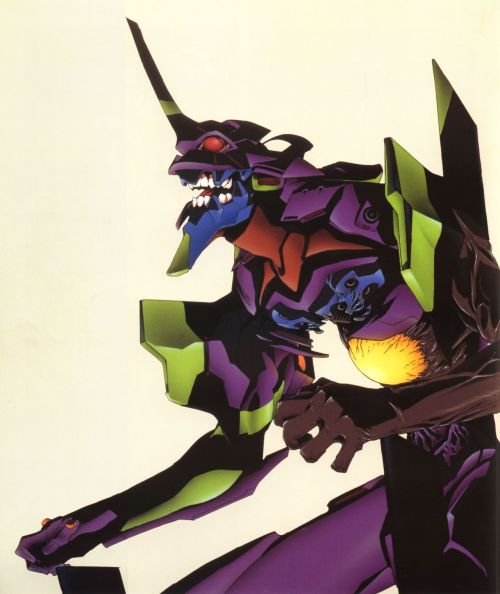
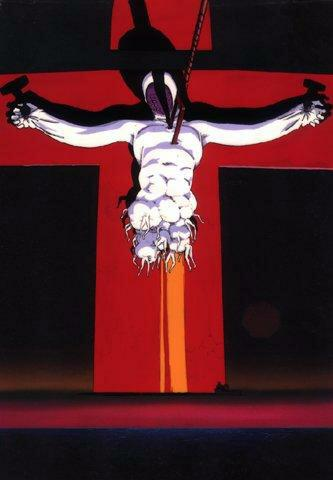
When I say totally mental I mean stuff like this. And this. And particularly this.
There is tonnes of crazy nonsense from this point on, as those pictures should illustrate, but the main important details are that Rei merges with Lilith, who takes Rei's shape and grows to the size of the Moon, then Shinji's Eva becomes both a giant crucifix and a giant tree and also merges with Lilith-Rei, and then everyone melts. Everyone. In the world.
You see, our human bodies are held together by something called an AT-field, which is generated by our soul, and not by the molecular bonds that hold together normal animals and every other form of matter in the universe. Angels and Evas are powerful enough that they can actually project their field (or their pilot's?) for use as a weapon or shield. Oh, and it stands for Absolute Terror field, because why not. When, in the series, Shinji melted in his pilot-seat, that was his AT-field collapsing and that, on a global scale, is what happens now.

This, at last, is what SEELE meant when they talked about the Human Instrumentality Project: the removal of unconscious psychic barriers between individuals and a return to the primordial soup. One enormous sea of souls, with shared experience and emotion; it's the end of pain and suffering and, most of all, loneliness. It's even accompanied by an upbeat, happy song - presumably to show how wonderful and euphoric it is.
It's also utterly demented.

I'll give it this, though: crazy madness it may be, but at least it's clear. We understand what's happening at all times - though NERV's second-in-command does outright narrate most of it to us (how does he even know this stuff?) lest we get totally lost. For perhaps the first time, we clearly and unambiguously understand what is happening in Evangelion, even if we're still not quite sure why it's happening.

What I don't understand is the sudden and jarring use of sexual imagery. There's nothing wrong with using sexual imagery in itself (at least, not if you have a point to make), but when you've been using another type of imagery - say, religious imagery - as strongly and as frequently as this show has, why throw a different and previously unused kind of symbolism in there too? What are you trying to say with that?
I get that giant naked Rei would be giant and naked - that's fine, and it fits the themes of Adam and Lilith and humanity's return to Eden ("Neo-Genesis" is almost right there in the title) - but why does she swallow Shinji's painful-looking Eva-tree into her face-vagina? Why does she have a stomach-vagina and hand-vaginas, for that matter? Why must we demonstrate the breakdown of AT-fields by having her sat astride Shinji, basically her own son, with their bodies merged at the crotch? Why do SEELE's Evas, who for some reason now all have Rei's face, writhe and moan orgasmically as they impale themselves on their spears? Why does Gendo grab her boob?
How does any of this fit with the Biblical myth motif that we've stuck with until now? I want to believe there's a valid reason for it, symbolic or otherwise, but I'm honestly not seeing one. It just feels gratuitous and gross, especially since it's all Rei - a passive, emotionless, child-like sex-doll.

I have heard theories that this unpleasantness is actually intentional; that the show is subverting anime-viewers' desire (perhaps even expectation) for sexualised fanservice. By giving them exactly what they want, but putting it in a highly disturbing context, it makes those viewers uncomfortable and disgusted in themselves.
That's the theory. My only response is to quote Yahtzee Croshaw: "Talk about it being 'ironic' all you want, but that doesn't change the fact that someone's rubbing themselves off to it even as we speak."

Fittingly enough, The End of Evangelion opens with an infamous scene where Shinji masturbates over Asuka while she's unconscious and injured in the hospital.
Many people use this scene as the go-to example of everything that's wrong with anime. Personally, I have no problem with it. It's icky, absolutely, but it's a very intentional character beat - showing us that Shinji is, in his own words, "so fucked up".
What I do have a problem with - what is an example, for me, of everything wrong with anime - is that it took us twenty-six episodes to reach this point. That's roughly thirteen hours with this character and, after all that, our best and only understanding of him is that he's pretty messed up.
Even worse is that, after a further ninety minutes, that's still the best we've got.

It doesn't look that way, though. It really seems like Shinji might have an arc this time, like Asuka and Misato before him. Unfortunately, this potential arc is delivered via the same introspective dream-bollocks the series wasted so much of our time with. As Shinji is absorbed by Lilith, his consciousness merges with Rei's and they talk over his problems. Yet again.
Despite the movie's increased budget, these dream sequences still devolve into the same characters-talking-on-a-minimalist-background that the series ended with. We also get incoherent scenes from Shinji's childhood (maybe), a montage of crayon drawings and the backs of animation cels, a bizarre fight with Asuka in their flat and, worst of all, a sequence of live-action clips of real people going about their lives. That live-action sequence is actually rage-inducing, as Shinji and Rei have an entirely nonsensical voiceover discussion about the nature of dreams that has nothing whatsoever to do with anything else in the film. Then, somehow, this navel-gazing causes giant-Lilith-Rei's neck to explode and she bleeds all over the Moon. Oh there you are, obnoxious ambiguity! We missed you.

Yet, tedious and annoying as this stuff is, Shinji does actually seem to be making headway as a character. He starts this psychoanalysis stuff unable to face life as an individual - it's all misery and pain, and everyone hates him. This comes to a head when he and imaginary Asuka have a weird argument that's mostly non-sequiturs, and he ends up strangling her. This is what drives Rei to make all the humans melt because, clearly, they just can't get along.
But then, after that insufferable live-action interlude, Shinji, straddled by his mother's naked clone child, begins to realise that life without individual people is no life at all; that his identity is defined by relationships to others. Without the potential for conflict, there is no potential for joy.
It's a simple, obvious point, but it's the closest this pretentious cartoon ever comes to being profound.

One interesting thing, for me at least, is that this is the complete opposite of the point the series was making. The original ending seemed to show Shinji embracing Instrumentality - welcomed into a communal dream-world by people both alive and dead. Here he rejects the process, choosing to remain an individual. I'm not sure what this change means exactly, but I thought it was interesting enough to mention.

With some basic truths finally figured out, Shinji's Eva bursts free from Lilith-Rei's eye (her normal eye, not her forehead vagina-eye) bringing an abrupt end to Third Impact. The giant Rei begins to fall apart, the souls go free, and Shinji's body reforms itself in Earth's new primordial sea. As he floats to the surface he has a positive life-affirming conversation with the soul of his dead mother (I've stopped trying to understand what, who or where her soul is at this point). Showing a hitherto unseen level of self-awareness, Shinji tells her that he'll always have doubts and fears about being alive, "But that's just stating the obvious, over and over."
Honestly, Shinji says that. Finally, this character seems to have evolved. He found some of the answers he was after, he figured out his crippling insecurity, he got closure with his mother, and he decided life is worth living. Character development! I may not have liked much of the fourteen hours it took us to get here, but I'm willing to give it a pass because, in the end, we did complete the main character's arc. There was a point to all this. That, at least, is something.

Except, of course, that the film's not over. There's one last scene, later, as Shinji wakes up on a beach of the new sea, with the remains of Rei's giant head decomposing in the background. He's lying beside an unconscious Asuka, who must also have reformed herself from the goo. Then, in a sequence designed to mirror the opening masturbation scene (random shots of the scenery over Shinji's quiet grunting) he strangles her. Just as he did in the dream, before he figured himself out. Then, when she unexpectedly moves, he stops and just cries pathetically to himself. Then Asuka calls him disgusting. Because he is.
Why does he do these things? What reason has this film given us for him to do them? There's only one answer we have: because he's pretty messed up. This is not a new, less insecure Shinji; it's exactly the same confused mess of a character from the start of the film. Which means that, ultimately, this is the same confused mess of a cartoon that it always was.

With that, all goodwill that The End of Evangelion earned evaporates. It gives us a great first half, with some of the best action and character-beats of the entire series - it even clarifies some of the show's more obscure loose ends - but then falls back into the same cycle of pretentious, repetitive nonsense. There's some imaginative imagery but, ultimately, it's just a meaningless parade of giant white boobs.
This film dealt with enormous, life-changing, world-shattering events. And Shinji learnt nothing from them. It seems Evangelion learnt nothing from them, either.


Rebuild of Evangelion

Ten years after the disappointing end of End of, Evangelion got rebooted. Still developed and created by much the same team that worked on the original version, Rebuild of Evangelion would be a series of four films that would retell the entire story in a shorter form with better production values. I was planning to avoid it - this franchise has wasted more than enough of my time - but, since the whole point of Mangaphobia is to give this stuff the benefit of the doubt, I clenched my teeth, downed a pint, and watched it anyway.

At the time of writing, the first three Rebuild movies have been released, but I have only been able to get hold of the first two. The first film is either called Evangelion: 1.0 or Evangelion: 1.11 - both titles are used and I don't know what the difference is - both with the subtitle You Are (Not) Alone. Because it just wouldn't be Evangelion without a title that doesn't mean anything.
1.1 is essentially the first five or six episodes of the series crammed into ninety minutes, with a few minor design changes (see: Lilith) and improved visuals. There's more CGI, for one thing, and some of the backgrounds are improved. It's basically the same, though, with the majority of it either using or possibly tracing the same animation.
I won't dwell on it, except to say that it's weird being reminded how great this show was at the beginning, back when it was fresh and interesting and full of promise. Maybe it's because this is streamlined into movie format, losing all the unnecessary stuff, or maybe it was always this good. Either way, the mysteries haven't gone stale and the characters haven't started annoying us yet. I still hated Shinji, of course, but that was residual hate from my prior knowledge, not because of anything he actually does in the film.
1.00 is good, in other words.

Then I watched Evangelion: 2.22 (or maybe 2.0) You Can (Not) Advance and, from the very beginning, it's clear that the game has changed.
We open with not just a sequence we've never seen before, but a character we've never seen before using an Eva we've never seen before to fight an Angel we've never seen before in a location we've never seen before. After a first film that stuck so close to the series, 2.20 is very very different. There are a few beats and events that we recognise, but they play out nothing like they did originally. This thing is very much its own beast.

It's not just different in the events of its story, either - its entire approach to telling that story is different. For instance: I now understand Second Impact. If you read my first post you'll understand just how big a deal that is. I don't yet know exactly what happened (in fact, what happened in Rebuild seems substantially different to what happened in the series) but I finally understand the significance and meaning of the event.

Second Impact was the literal wrath of God.

Whatever form the events took (the oceans turned to blood, for one thing) they left humanity with absolutely no doubt that God is real and that He is vengeful. This is something that becomes apparent while Misato says Grace and eats her lunch, and that unassuming little scene explains so damn much. This is a world where religion is an accepted fact - where it would influence everything, from science (souls, AT-fields) to business (SEELE, NERV) to politics (the Eva project, Instrumentality). This is a world where it actually makes sense to follow the instructions of the Dead Sea Scrolls. It explains everything.
Finally, after sixteen hours of dancing around its own premise and never giving an inch, Evangelion just hands us the information we need to put everything together, and it all suddenly clicks into place.

This was such a shock to the system that I wasn't really sure what was going on any more - and it was far from the only shock. Rei was smiling and showing emotion; Asuka was openly expressing her feelings; Gendo was acting like a human being; Shinji was displaying social-skills and even had friends! What the hell was I watching?!

The friends in question are a couple of boys from school, who Shinji saved from an Angel in the first film. He saved them in the series, too, but then one of them was almost immediately involved in a horrible event which almost killed him, and we never saw either of them again. In this film we actually get to see Shinji and these guys hanging out and having fun - Shinji actually has a personality, it seems, and he's beginning to come out of his shell.
The same horrible event does occur here, too, but it doesn't happen to a minor side-character - it happens to Asuka. This comes just as the three pilots are really starting to connect and bond, so the shock of the event, and its effect on Shinji, are far more powerful and earned than they were in the series. In both versions, it causes Shinji to quit - but where, in the series, he returned to NERV apparently on a whim, in Rebuild he makes a very conscious decision to go back and help Rei. It's driven by character choice, not by story requirement.
2.02 ends, incredibly, with Shinji Ikari personally causing Third Impact through sheer force of will, driven by his overwhelming determination to save Rei. This is pretty much the polar opposite of the passive introvert sociopath he's always been until now. In End, I considered it progress when Shinji learned the simplest of life-lessons, but now here he is reshaping the world through his own agency and choices.
I can't believe I used to hate this guy!

Evangelion: 2.202 is a revelation. It's what Evangelion always should have been. This cartoon always had such potential, but the show just left it there to stagnate. 2.2 is what that potential looks like when it's actually realised.
The characters are multi-layered and relatable, neither of which were true before, and they progress and change along actual arcs. Those arcs are then intertwined with the main arc of the story, so that the drama is always personal and engaging, and we always feel meaningful stakes. There's perhaps less fights - the Angels are mostly of the weird-geometric-shape variety - but the action is always informed by character and the final battle is spectacular and huge. It still has mysteries and weird mythology, but they're less invasive and, thanks to our better understanding of the world and our newfound investment in the characters, we find them more engaging. Actually, because of the new girl and her unknown agenda, even the mysteries are grounded in character.
After getting so much wrong for so long, it's ridiculous how much this movie gets right.


It's barely one month since I started Mangaphobia, and already this project is paying off. Left to my own devices, I would have stopped watching after The End of Evangelion and never looked back. But, because of the pledge I made on this blog, I forced myself onwards and actually found a smart, engaging anime that I really enjoyed. It's a start!

I'm now completely torn on whether or not to hunt down a copy of Evangelion: 3.?! You Can (Not) Redo. On the one hand, the Rebuild series seems to be blossoming into something fairly special but, on the other hand, I've been burnt by this franchise before. Twice.
It can't be long until Shinji starts repeating his issues ad nauseam and Rei starts growing extraneous vaginas, and I don't want to be there when that happens. But, on yet another hand, the preview shows Asuka looking badass with an eyepatch, and I would very much like to be there when that happens.

I think, rather than watching it now and having to write the third Evangelion post in a row, I'll hold off watching the third movie until the fourth one, Evangelion: Final, is released and I can watch them both together. I hope they change that title, though, because It Does (Not) Conform.

Tuesday, 27 August 2013

Mangaphobia 02: Neon Genesis Evangelion

I admittedly haven't seen much anime - that is the whole point of these blogs, after all - but, even so, there are certain repeating ideas that even I can't help noticing crop up again and again. In the handful of sci-fi I've seen, for instance, the world has almost always been ravaged by some ill-defined catastrophe in the recent past. A world-changing disaster that everyone knows about but never really talks about. If I had a better grasp of Japanese culture I might be more confident saying why - but it seems likely that, like Godzilla, this is an echo of the atom bomb.
Mentioning only stuff I've seen and remembered (which isn't much) Akira had the Akira Incident, Nadesico had the Jovian War, and last episode's Cowboy Bebop had something called the Astral Gate Accident. In Evangelion (or Neon Genesis Evangelion to give it its full, meaningless nonsense title) something terrible happened fifteen years before the series - an event called "Second Impact" - which irreparably altered the lives of everyone on Earth.
All of these apocalyptic events are kept ambiguous and vague - we know only that they happened and that they were very bad - but where Akira is ambiguous because no-one really knows what happened, Bebop is vague because the Accident doesn't actually affect the story, and Nadesico is secretive because the details of the War are being actively covered up, Evangelion withholds everything about Second Impact just for the sake of being withholding! Everything that happens in the show is a direct consequence of that event - it informs every facet of this world and its characters - yet we're never told, even in broad terms, what it actually was.

That's one of Evangelion's two main problems in a nutshell. Nothing is ever clearly explained at any point. Ambiguity is fine in small doses, but when every single thing is kept uncertain and unclear, nothing ever means anything. Naturally this is less of a problem at the start of the series than the end - as the early mysteries seem as though they might lead somewhere, and maybe even have solutions that make sense. But no, when we reach the big expository reveal scenes later on, they're just as ambiguous as the questions they attempt to answer.
Take a scene near the end of the series, for example, where we discover that one of the characters is a clone (which we'd already guessed anyway). We end up in a laboratory full of identical girls floating in tanks, all dead-eyed and unmoving. These are empty human husks, we are told, that contain no soul. Now, the specifics are about as clear as mud, but I think the clone we know as a character does have a soul - I'm pretty sure it's the soul of the main character's dead mother, or possibly a clone of that soul, but that doesn't make any sense and how did they get hold of a dead woman's soul either way? It's possible the clone girls may actually be bodily clones of the mother, too, but that's somehow even less clear.
While a bit confusing, it's at least semi-coherent - but then it plunges into the abyss. We're told that these clones are secretly being used as autopilots, even though they're just lifeless shells, and even though the autopilots we've seen in action were psychotic automated murder-bots. This is presented as the shocking answer to the big autopilot mystery (one character almost says exactly that), but I didn't realise the autopilot was ever a mystery in the first place (I assumed it was just that - an autopilot) and, even if it was a mystery, this solution solves absolutely nothing and just makes the already mega-confusing mythology even more murky and incoherent! When the series is over, we understand far far less than we ever did before.

It's the same mistake Prometheus makes: not explaining everything is not the same as never explaining anything. A few mysteries, like the exact origins and motives of the monstrous Angels, can actually benefit from ambiguity - but there's no benefit to being equally vague about important central story questions like, say, what the hell are the goddamn Evangelions, anyway? I read online that they might be yet more clones of Shinji's mother and, if that is the case, then I really have no idea what this show is even about.

So what is it about?
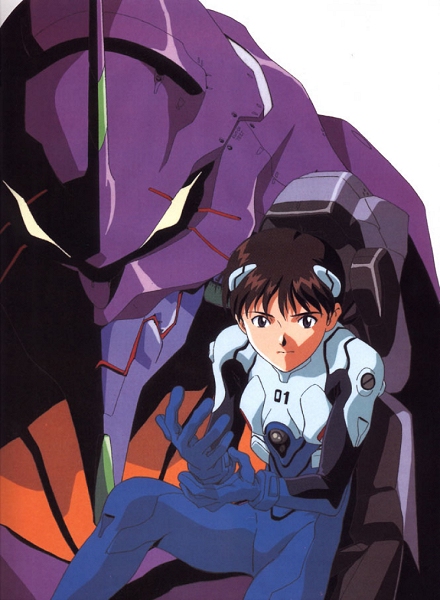
Xenon Genesis Evangelion is about a teenage boy called Shinji Ikari who, after receiving a message from his long estranged father, goes to meet him for the first time in years. He arrives just as a giant monster attacks the city, and it turns out his father doesn't want to talk or reconnect - he just needs Shinji to pilot a giant robot for him. Because, naturally, only certain teenagers have the ability to synchronise with these mechs. Shinji's understandably reluctant and more than a little unhappy with his dad (there's screaming and tears), but eventually he goes along with it and somehow beats the monster attacking the city - albeit getting his robot torn to pieces in the process. Shinji agrees to keep piloting, despite utterly hating the experience, and from here we meet the various other pilots, scientists and soldiers that make up the anti-monster military agency NERV.

Simple as that sounds, we're actually hammered with mythology and mysteries from the very beginning. The robot in question is an Evangelion (or Eva), which is definitely part-organic and quite possibly alive; the monster is an Angel - one of several unearthly attackers prophesised by the Dead Sea Scrolls; NERV is controlled by some shadowy organisation called SEELE, who pretty clearly have an ulterior motive for all this; and there's something very fishy about the ethereal Rei Ayanami, NERV's other Eva pilot (spoiler: she's a clone).
On top of that plot-relevant stuff, there's also a whole host of Christian imagery and references used - from the names of NERV's three supercomputers (Casper, Melchior and Balthasar) to the Angel exploding in a cross-shaped beam of light when it's killed.

At first, that Christian stuff just seems to be decorative - adding some interesting flavour to this world and its imagery - but as the series progresses, we find that it goes much deeper than that.
The first clue, seen above, is an off-hand mention of the Dead Sea Scrolls. This is a science-fiction mecha show where the soldiers and scientists are getting their information from a two-and-a-half-thousand-year-old real-world religious text.
That's... odd. It gets odder still when we learn later that SEELE's entire shady gameplan is to doggedly following the Scrolls to the letter, for no readily apparent reason.
Things finally go from odd to batshit when Shinji's commander - a woman called Misato Katsuragi - takes him into NERV's cavernous basement and shows him a giant blobby monster-thing that they keep down there nailed to a cross. This is an ancient and powerful being called Lilith - the first wife of Adam in real-life Biblical myth (Lilith was created equal to Adam and refused to do his bidding, so God replaced her with the inferior and subservient Eve). Lilith and Adam (another giant monstery thing) are important because they're somehow involved in the unclear events of First and Second Impact (First Impact being a similar event that happened millions of years ago and kickstarted life on Earth... I think). It seems like this stuff is common knowledge, too, because Shinji doesn't freak out or ask any questions about the insane things he's being shown.

A big problem with all this is that we have no idea how literal Evangelion is being. Sometimes people in the show talk about this stuff like it's a metaphor - like Lilith and Adam are our genetic ancestors in an evolutionary sense - and other times it sounds entirely literal - like they are literally the direct progenitors of the human race. We learn later on that the Angels are God's various prototypes for humans, before He settled on our own tiny, weak, fleshy design. I can only assume that's meant exactly as it sounds, because I have no idea how else it could be meant. This is a cartoon where people are following the literal instructions of Biblical texts, yet the same people have developed a very non-religious, scientific definition of the soul.
Souls, by the way, are incredibly important to every aspect of this mythology, and are the most inadequately explained aspect of the whole mess.

Getting back to the story, Misato explains that the Angels are attacking in an attempt to reach Lilith and that, if they ever succeeded, doing so would cause the hypothetical Third Impact, which would be much bigger than Second Impact, but probably still just as ambiguous and unclear.
What's weird is that when SEELE's sinister motives are finally revealed, their endgame is also to cause Third Impact - beginning something called the Human Instrumentality Project, which will bring about "the next stage in human evolution" (a phrase which always makes my brain bleed). Why did they pour their worldwide resources into stopping the Angels if they ultimately wanted the same thing? Well, because the Dead Sea Scrolls told them to, probably. Those guys seriously have no motive beyond fulfilling ancient prophecies.
It's ok, though, because Gendo Ikari, Shinji's absent father and leader of NERV, knows what SEELE are up to and has no intention of letting them get away with it. It turns out he had his own secret plan all along: to initiate Human Instrumentality by causing Third Impact!
Wait...

All three major factions in this programme want the same thing - namely the end of the world. It's possible that it will happen in slightly different ways depending on which party actually succeeds, but it's still pretty damn hard to root for anyone when the thing they're fighting over is who gets to press the big red apocalypse button.

The answer to this should be obvious. If we can't root for NERV or SEELE or the Angels, then we should be rooting for Shinji and Misato and the other characters who are just doing their jobs and fighting monsters and aren't trying to bring about the end of the world. But that brings us to the second major problem with Argon Genesis Evangelion: there really aren't any characters. What there are instead is cardboard cutouts defined by one trait and one trait alone, who never progress or change or learn anything.
Shinji is scared of everything - Angels, responsibility, death, change - but mainly he's afraid of human interaction. Gendo loves his dead wife and feels nothing else, which is why he doesn't care about his son and why he's only nice to Rei who is carrying his wife's soul (probably). Misato is good at her job and bad at her life, with problems in all her personal relationships. Rei is an actual cardboard cutout, with seemingly no emotions or personality - a hollow, empty robot, despite being the only clone with a soul. That's it! You now know everything there is to know, in the entire series, about every one of those characters.
The only others in the show are the third and final Eva pilot - a German girl with the very German-sounding name of Asuka Soryu - and NERV's head scientist - a woman I neither know the name of nor care enough to find out. These two are unusual in that they almost have character arcs - but really they are just as paper-thin as the others; it only looks like an arc because they hide their one-note personalities behind a mask of cocky overconfidence and scientific detachment respectively. In Asuka's case (it's pronounced "Oscar") this psychological armour falls away slowly over the series, revealing a little girl who is, if anything, even more terrified of life than Shinji. The scientist just seems to be a bit cold until, near the end, it's suddenly revealed out of nowhere that she's (a) sleeping with and possibly in love with Gendo and (b) stressed, depressed, violent, suicidal and crazy. These two are still shallow, unchanging characters - they just pretend to be different shallow, unchanging characters for a while.

It's been proven already this year that you don't need particularly deep or complex characters to make an awesome giant robot story. Pacific Rim doesn't really have much in the way of character arcs either - the archetypal characters simply do their thing - but it differs from Evangelion in two major respects.
Firstly, the characters are relatable. It's important to realise that isn't the same as "likable" - it just means that we can understand their mindset and why they act the way they do. Shinji, at first, is a highly relatable character. He has issues with his parents (don't we all?) and he's flung into a terrifying situation that he doesn't understand and is told he must do something he doesn't know how to do. For the first few episodes, we are very much on Shinji's side, because we understand exactly how he feels, and we’re interested in watching him rise to the challenge and seeing what kind of character he will become. But he never rises. He just wallows in self-pity and stagnates. He passively goes along with whatever he's told, and then cries about it later. We don't understand what he wants or feels anymore - he never rises to the challenge, but he never rebels against it either. He doesn't act like we would or like anyone we have ever met would. We can't relate to this guy at all beyond those first few episodes and, after that, he mainly just frustrates us as viewers. I was shouting at the screen more than a few times as I was forced to watch Shinji struggle again and again with not making any choices.
I hated him, by the end. I really really hated the main character and his total lack of agency. I didn't understand him or anything he did or (more frequently) didn't do. It's awful. All of the characters are awful, in fact. I couldn't stand any of them, because their motivations are never relatable at all - I couldn’t understand why anyone did what they did or made the choices they made. Looking back at the list above, the only ones that resemble real people are Misato and maybe Asuka - and Asuka frustrates us anyway because she just slowly turns into Shinji.

The second difference here is that Pacific Rim knows that its characters, while relatable, are shallow and silly. It doesn't dwell on them beyond a few basic flashback scenes. It tells us who they are, then it gets on with the story. Evangelion, on the other hand, seems to think its characters are incredibly deep and worthy of extra exploration. We spend what feels like forever psychoanalysing Shinji - literally, with him sat talking about himself to unseen observers - even though his psyche is about as deep as a puddle.
Shinji is scared of rejection, so he closes himself off from people, which makes people reject him, which makes him even more scared, which drives him even further into himself until he is insufferably insular and passive. That's it - that's all there is to Shinji Ikari - and every single viewer has worked that out by this point. It's not hard. We worked it out, funnily enough, by observing his decisions and interactions with the people around him - which is traditionally how you're supposed to explore character in narrative fiction. If you have to spend an entire episode inside a character's head, monologuing about their own personality, then you are doing it wrong. If you have to spend four or five episodes doing that, with a character that can be decisively summed-up in one sentence, then you probably shouldn't be writing stories in the first place. Shinji just repeats that single motivation (or demotivation, since it drives him to indifference and inaction) over and over again. There's an episode somewhere near the midpoint where he synchronises so perfectly with his mech that he physically becomes one with it - melting into a liquid in his pilot-seat (don't worry, he gets better). While he's dissolved into his Eva, his consciousness (soul?) goes on a voyage of self-discovery - which means we get to see how many different ways the writers could come up with to keep repeating the same thing. One way they found to keep it interesting is to have him talk over erotic dream images of the female cast, including the infantile clone of his own mother - so we do learn that he objectifies women, which I suppose is something we didn't know before. But that's about it.
When this godawful introspection is over, he seems to maybe have learned something from it. His body reforms itself when his soul comes to some kind of conclusion, so it looks almost like character growth. But in the next episode we're straight back to the same, inexplicably hopeless Shinji - and we're straight back to wanting to cave in his head with a brick. For me, this was the final nail in the coffin of the show's credibility. Which is probably for the best, because it meant I wasn't expecting much in the way of an ending.

At the end of the series, after NERV beat the final Angel - a white-haired anime girly-man with whom Shinji has a homoerotic friendship (obviously) - the studio ran out of either time, money, or both. There was no way they could patch together a satisfying ending (or any other kind of ending) so they didn't even try. The last two episodes, instead, are a bunch of floaty images on white backgrounds while Shinji talks about his issues. Or, rather, his one issue. Again. And again. And again.
This is actually painful at this point. We can't take any more - so two whole episodes of it feels like torture. Or maybe punishment for our sins - the show is certainly big on that Wrath of God stuff! There's a weird bit where we see the characters in some kind of school-comedy version of the show, where Shinji sees what his life would be like without the Evas, but I don't even remember what we learned from it and I certainly didn't care. I just wanted this stupid nonsense to be over.
The abstract weirdness of these two episodes isn't actually as out of place as it sounds, since the programme has been getting weirder and weirder for quite some time. It's implied (though I don't remember exactly how) that what we are watching is the Human Instrumentality Project in action - that, after the last Angel, SEELE caused Third Impact, and this is Shinji's introduction to their brave new world. Eventually, when the end finally, mercifully comes, Shinji meets up with everyone he's ever known - alive or dead - on a blue asteroid floating in the whiteness. They applaud and welcome him with open arms - Gendo even smiles. It's all very lovely and symbolic. And, because Second Impact, Third Impact, and Human Instrumentality were never properly explained or defined, none of it means a damn thing.

Brightly-Coloured Genesis Evangelion is, more than anything else, a hellishly frustrating experience. It has such obvious and wonderful potential which it never even comes close to paying off. It begins so strong - with characters we think we understand and relate to, interesting themes and symbolism, intriguing concepts and mysteries, and hints of a deep, complex mythology - and then it squanders every single one of those things by never advancing them further than those initial ideas. The characters don't progress, the themes don't lead anywhere, the mysteries don't get solved, and the mythology never makes any sense at all. At the start I really thought it was going to work; at the end I don't think it worked on any level.

It’s also not done me any good in terms of opening up to Japanese animation. I watched this show at university because people kept saying it might change my mind, but it actually just reinforced every half-baked prejudice I had. This is a giant robot show where the main characters go to a sailor-suited school together and the hapless male character is surrounded by a harem of fetishised women. Much as I love giant robots, that's three eye-rolling anime clichés right there in the concept.
On top of that, the production values and animation fluctuate wildly, which is another thing that always annoys me about anime. It has great, dynamic fights - but these become fewer and shorter as time goes on, and they're punctuated by standing and talking scenes where no-one moves for minutes at a time. Gendo almost always sits with his fingers arched in front of his face, which means they couldn't even be bothered to animate his mouth. Whenever he talks we're basically looking at one static image! That's not even mentioning the cheap slideshow that passes for a conclusion.
It has those jarring anime swerves in tone, acting morbidly serious all the time, except when it's the complete opposite - look, Misato is drunk and she has an adorable pet penguin called Pen-Pen, haha! And, of course, it has the other kind of "humour" where Shinji goes to Rei's flat and somehow ends up in her underwear drawer and then she comes out of the shower practically naked and then he ends up on top of her somehow and why the hell is this scene happening? And why is there a beach episode - why is there always a sodding beach episode?
Unfairly, I even dismissed the storytelling as being "too anime". When I talked about Cowboy Bebop, I said the storytelling felt more western, in that it was familiar and comfortable. The storytelling in Evangelion is the complete opposite - alien and strange. It’s obscure and unhelpful and confusing, and it refuses to give the viewer anything on which to build a coherent picture of the plot. The character work is equally alien, apparently assuming we’ll be interested in these characters just because they are the characters and not because we understand or feel any empathy for them.
Oh, and there’s that skinny white-haired ponce.

But Evangelion’s biggest sin is not anime-specific; it’s that it just comes off as pretentious. It seems to think it’s being oh so clever, when in fact it’s saying nothing at all. We spend multiple episodes just exploring Shinji’s personality, to no real end other than to force some psychology in there and not gain anything from it. The same goes for the Christian stuff - or even the non-denominational spiritual stuff like "souls" - in that it seems to be incorporating huge universal ideas of religion and meaning, then doing nothing with them. It doesn’t draw any conclusions about anything, and it seems almost proud of that fact. Like Lost or (you guessed it) Prometheus. Sure, you can find meaning in it - if something is vague enough then you can find pretty much any meaning you want. "Open to interpretation" can be intentional and thought-provoking, but it can just as easily be a crutch. I know which it feels like here.

So, at last, we come to the end of this monstrous post. It ended up a lot longer than I intended, but I hope you stuck with it and made it to the end. I also hope you enjoyed it because, if not, I have some bad news: I’m not done with Evangelion just yet. There’s more. After the phenomenally poor ending of the series, enough money was made to create an alternative version which, if nothing else, wouldn’t just be a whiteout with floating images. Then, after that, they rebooted the whole series.
I had hoped I could squeeze all this into one post, but (as I’m sure you’ll agree) this has already gone on for way too long. Instead, the next episode of Mangaphobia will take a look at all this stuff, and I think you might be surprised. Hopefully that post will be up some time next week, and hopefully it will be a lot shorter than this one.

Until then, to sum everything up, I will leave you with the same question that I posed over three-thousand words ago: what the hell are the goddamn Evangelions, anyway?
To begin with, we think they’re partly-organic machines, but it becomes quickly apparent they’re mostly, or maybe entirely organic. They're basically giant humans with metal plates on the outside to make them look like robots. They are humanity brought to its full potential, we're told. Except we’re also told they’re clones of Adam; or possibly Lilith (or possibly Shinji’s mother). We do know that it's your soul that synchs to the Eva, not your body or mind. But if you synch too well the thing goes feral, meaning that... the Eva is in control of the relationship, not the human? Except that they also go feral under their clone autopilots, which don't have a soul at all. They definitely seem to be alive at all times (they need to be restrained by mechanical implants, both when in use and in the hangar) but it's never clear if they’re merely alive like an animal, or alive like people and Angels, with souls of their own. Would having a soul mean they’re sentient, or just dully conscious? Are these things slaves, or just tools?
The first episode sets up the Evas as being more than they appear. It was this mystery that most grabbed my attention and drove me to keep watching. Yet I still have no idea what an Evangelion is. And I have no idea if or why that even matters.

Thursday, 15 August 2013

Mangaphobia 01: Cowboy Bebop

Hello and welcome! This is the first episode of Mangaphobia, my new series chronicling the adventures of me, a seasoned anime-sceptic, as I dip my toes into the slightly frightening world of Japanese animation. Read the introduction to get up to speed, then join me as I try desperately to better myself.
First up is the cartoon that inspired me to begin this quest in the first place:


There's something decidedly western about Cowboy Bebop.
I mean, obviously, the word "cowboy" is right there in the title, but that's not what I'm talking about. It's hard to pin down, but I think it's a structural thing - something about the way the stories are built and told. Maybe it's a more recognisable three-act structure, or more pronounced character-building (anime often seems to just assume you'll accept blank characters). Whatever the reason, it just feels familiar, somehow, where a lot of anime seems detached and alien.
That's obviously my prejudice talking. Not a negative prejudice - not xenophobia or racism or anything - just that, culturally, I'm not equipped to understand the conventions of Japanese storytelling. That's probably one reason anime usually leaves me cold, and why Bebop makes such a good entry-point.

Another reason Bebop works for me is that it puts spaceships together with country music which, for some unknown reason, just feels right.
In fact, the whole show has a deep fascination with music. The episodes (which are even referred to as "sessions") have titles like Heavy Metal Queen and Black Dog Serenade, and the brilliantly integrated soundtrack is full of jazz, rock, blues, country and (of course) bebop. The show's musical leanings also result in, without a doubt, the single coolest intro-sequence of any programme ever. Oh yeah.

The "cowboy" of the title doesn't actually refer to the Western influences (though they are certainly there), rather it's a term this world uses for bounty-hunters. Our heroes are a ragtag band of such cowboys who live and travel on a rusty old ship called Bebop.
Spike Spiegal is the scrawny, sharp-suited scoundrel with big hair, massive clown feet, and a penchant for martial-arts. Jet Black (yes, really) is the rough, tough, gruff mechanic with a robotic arm and a heart of gold. Faye Valentine is the charming thief, who can weasel her way into anything but can't always weasel back out. Radical Edward (yes, really) is the prepubescent master-hacker who is probably crazy and, despite the name, definitely a girl. And Ein is the ship's pet corgi, who may or may not secretly be a super-genius.

Wow, that seems really silly written down. And it is silly, of course - when Edward's involved it often gets outright surreal - but it's weaved throughout the serious stuff in a way that makes it work. The moment that I officially fell in love with Bebop, in fact, was when I realised that the creepy, atmospheric episode I was watching had actually been an absurdist Alien homage all along.
A lot of anime seems oppressively over-serious; either with no humour at all, or with sudden, jarring shifts from crushing darkness to, "Look, a funny animal!" or, more often, "Look, he tripped and groped her boobs!" Cowboy Bebop is much more even and level - it sprinkles light humour throughout, but never really strays into stupid, obvious, or boob-centric jokes. Conversely it handles even its most serious episodes and moments with a gentle touch and a streak of fun (see: the last shot of the entire series). This is, again, something that feels unusually western to my prejudiced eyes.

You wouldn't know any of this from the beginning, though. The first episode, Asteroid Blues, had me groaning with disappointment and dreading watching the rest. It was exactly what I was afraid it would be, with an overly dour "edgy" plot about drugs and violence, endless slow pans and still-frames to save money, and several pervy boob closeups; the only levity was three random old blokes that seemed painfully out of place, and a lot of the voice-acting was terrible. It's probably my least favourite episode - it's a bloody awful place to start.

The second episode, Stray Dog Strut, is much less serious. There's a case of mistaken identity, a long slapstick dog chase, and a character who has a tortoise on their head. But, coming off the back of the po-faced Asteroid Blues, I had no idea how I was meant to process this. Going back to it, it's actually quite a fun episode but, at the time, I didn't realise it was trying to be fun, so I wrote it off as some bizarre misfire.

Episode three is where it finally clicked. Honky Tonk Woman opens with Spike and Jet kicking back in a casino - the music, the lights, Jet’s outfit, and the fact that they're bickering like an old married couple all make it feel like an Ocean’s Eleven-type caper. Then everyone’s plans go wrong - both theirs and the bad-guys’ - there’s double-crosses and ransoms and exchanges, and it ends in an inventive and spectacular shootout on the outside of the ship. It’s great and exciting and fun, and I suddenly understood what this cartoon was.

From there the show quickly finds better footing, and settles into a comfortable rhythm (fitting for a show so obsessed with music). At every scale and every level it is balancing itself - every serious beat is offset by a moment of levity, and every heavily serious episode is followed by a slightly offbeat one. It’s so well-calculated that you don’t even blink when Ed finally turns up, nine episodes in, and things start getting really whacky. Bebop is surprisingly versatile.
As a general rule, the lighter episodes tend to be standalone affairs, where the crew face a new challenge in a new location with new characters, and it all wraps up by the end of the session (like the aforementioned Alien homage, the magic mushrooms, or the time they meet an actual cowboy). That’s not to say that standalones never get serious and deep - there’s a couple that are absolutely horrifying (Pierrot Le Fou springs to mind) - but the more consistently serious ones are episodes that deal with our characters’ pasts.

Spike, Jet and Faye all have emotional damage and secrets that get slowly explored throughout the series. We do get a glance into Ed’s history, too, but since her experiences have left her either totally unphased or completely broken (it’s hard to tell which) we never really learn much.
The main arc of the series is Spike’s and, for me at least, it’s the least interesting and least engaging thing about the whole cartoon. His story is, at the risk of appearing even more biased, very very anime. It’s about his lost love, and his dark past with the triads, and the betrayal of the man he once viewed as a brother. That betrayer, a man called Vicious (bit of a giveaway, guys), is one of those patented tall, white-haired girly-men with a billowing coat and an improbably deep voice - I can picture some of my friends swooning even as I type that - and I just couldn’t take him seriously at all. I was rolling my eyes whenever he stalked effeminately onto the screen. This might have been ok if the show retained its sense of humour, but Spike’s past is treated with even more severity than the opening episode - his episodes are unrelentingly heavy and grim. Spike’s much more interesting in the episodes that aren’t about him, when he’s kicking arse and cracking wise and isn’t tied down by this rote, overplayed anime story.

I’m willing to overlook Spike and Vicious, though, because the other main stories are so much more interesting. Jet’s an ex-cop, and his episodes play out as gritty noir thrillers as we learn why he had to leave that life behind, and how he lost his arm. True to its noir stylings, while there is action, his stories burn slow and mostly deal with moral greys and difficult choices. Where Spike’s out for simple revenge and is otherwise a free spirit, Jet’s conflicts are more complex and difficult; his life and past rubbing up against his beliefs and ideologies. It paints a wonderful portrait of a man left behind by a changing world.
Faye’s story is the slowest to be revealed - with hints early on and then nothing for almost half the series - and it becomes a haunting tragedy. She’s actually suffering from amnesia, which sounds clichéd but works well when we learn that she was cryogenically frozen for fifty-four years after an accident. With not only no memory of her life, but also no way of returning to it even if she could remember, her journey is heartfelt and bittersweet.
Much fun as it is to watch the crew bounty-hunting, dealing with big, scary sci-fi concepts, and hunting for Betamax players (don’t ask), it’s the depth of the character exploration that really makes Cowboy Bebop stick. Thankfully, in most cases, it’s a damn sight more effective and affecting than anything we learn about Spike.

Bebop is the first anime series I can unreservedly say that I liked. In fact I kinda loved it. It still suffers from many of the juvenile and exploitative things that anime always seems to suffer from - as well as Spike’s self-serious melodrama there’s the ever-present fact that Faye dresses like a prostitute, the first episode’s boob-cam, a sequence involving suncream and, um, this guy - but it manages to tell stories that are interesting with characters who are engaging and themes that it actually sees through to the end. I called the storytelling "western" before, but I’m pretty sure that’s unfair - wherever you’re from, this is just good storytelling.
My main complaint, weirdly, is about the Bebop herself. If you ask me to draw the Starship Enterprise, I can. If you ask me to draw a Firefly, I can. If you name any ship from Star Wars, I can tell you what it looks like. Even the Planet Express ship! There are three smaller ships inside Bebop that are all iconic and memorable, but the actual Bebop? I have no idea what Bebop looks like and, considering how much time we spend with her, that’s a damned shame. But, when that’s the strongest complaint I can really muster - about an anime, of all things - then that just shows how much Cowboy Bebop gets right.


Thanks for reading, anime peoples!
I got loads of great comments and suggestions last week about where I should take Mangaphobia going forwards. Death Note and one of the Full Metals (Alchemist, I think?) seem the most popular choices, but I’d still appreciate any other suggestions you may have. Before I dive headlong into a time-eating TV series, for instance, what movies do people suggest? Ghibli, I’m guessing, but which ones?
I’m hopefully seeing The World’s End tonight (finally), so reviewing that will be my next mission, but after that I hope to return with the second episode of Mangaphobia: a retrospective on the various different versions of Evangelion. See you then!