Tuesday, 9 July 2013

Avatar: The Glory of Aang

In my last post I said that Avatar: The Last Airbender is one of the best animated series ever made; then I proceeded to rip it to pieces for its disappointing cop-out ending. I feel bad about that.
As I said, I love Avatar - but that's probably not the impression that last post gave. So, to restore balance to the Force (or possibly to the chakras), I'll be using this post to look at the things the show gets right.

If you were to ask me which is the best season of Avatar my default answer is, and always has been, Book Two: Earth. But now, watching it back for the umpteenth time, the second series seems to have a lot more fluff and filler than I remember. Stuff like that swamp episode, or the first three quarters of The Chase. Tales of Ba Sing Se is blatant filler of the most gratuitous order (though Sokka makes it work). Likewise Avatar Day (likewise Sokka). That's not even mentioning the entire subplot with Appa!

Book One has a lot less of this - or rather, if it does, it hides it better. There are filler episodes, but at that point we're still learning about Avatar's world, so even filler is interesting and new and educational. The only ones that really stand out as obvious fluff are The Great Divide and The Fortuneteller - but even those serve to teach us more about these characters we're still getting to know (and the latter gets a pass anyway on the strength of just one line).

Book Three is similar in that we've never visited the Fire Nation before that series. Again the filler episodes are teaching us about this new environment, and about the people living there. Up 'til now our only experience of the Fire Nation has been their military - faceless soldiers who do bad things. Episodes like The Painted Lady, or that weird Footloose one, show us that people in this land are just as oppressed as those in the Earth Kingdom - even while they're blatantly killing time before the real meat of the series begins.
Series three is also the first series to really embrace what Tales of Ba Sing Se tried to do, which is to just go crazy with it. The Play and the amazing anime beach episode (also, somehow, very important to the plot) are both half-an-hour of winking and nudging the audience - and Daydreams and Nightmares is just plain bonkers (did I mention that everybody loves chakras?).

So why do I prefer Book Two? As a series it's essentially treading water until Toph arrives in episode 6, and then it wastes even more time when we reach Ba Sing Se. Again, not even mentioning Appa's subplot. It has (discounting the finale) the deepest, and the longest, low-points of the entire show.
But it also has the highest high-points. Zuko Alone is one of the best episodes of the entire programme. The end of The Chase (after a pretty poor first half) is also brilliant. Zuko's entire second series arc, in fact, is one of the best things in the entire run - and it has that bit where Uncle sings.
Series two also introduces Toph, who is obviously amazing, and Azula, who is obviously terrifying. Azula's far more effective as both a character and a threat than either Ozai or Zhao (and infinitely better than Sparky-Sparky-Boom-Man) so this series has the best villain too.
But the real reason that Book Two is my favourite is how coherent it is as a complete series. The way that, from start to finish, it's always about the same few things, and how those same things all collide come the finale.

Think about the final battle of each series. In Book One, Team Avatar must save the North Pole from a Fire Nation attack - something that is only set up a few episodes earlier. There's also some business with two mystical koi fish and Sokka's new girlfriend, both of which are also introduced in the last few episodes. It ties in with a recurring theme of technology versus nature (and skepticism versus mysticism) that crops up throughout the first season, but that's about it. Don't misunderstand, though, this ending still works pretty damn well.
In Book Three, Team Avatar must stop the "Phoenix King"'s ridiculous plan to (literally) set the world on fire - something that's never ever mentioned before the finale itself! Also energybending and lion-turtles and Aang's unwillingness to kill (he's blown up a lot of ships and tanks at this point) are all clumsily introduced during the ending itself. It doesn't even have the thematic anchor of season one's ending. This ending does not work so well.
In Book Two, by contrast, Team Avatar must prevent the Fire Nation from conquering Ba Sing Se, capital city of the Earth Kingdom. This conflict is set up in the first episode of the series - maybe even before that, in season one. Everything else about that ending - the temptation of Zuko, Aang learning to let go, everything with the Dai Li - is set up and foreshadowed throughout the series. The only thing that feels out-of-nowhere is the sudden introduction of Guru Pathic - but we did already meet him briefly in Appa's Lost Days and, unlike energybending, the aid he provides is something Aang knew existed and has been searching for for some time.

Every episode (except, perhaps, that swamp one) pushes forwards these themes. Episodes I’ve already described as filler are nevertheless focused on the central concepts of the series. Both The Cave of Two Lovers and Return to Omashu, while not progressing the overall story very much, highlight Aang’s reliance on emotional attachments (to Katara and Bumi respectively) and the entire Appa plot, much as I keep joking about it, does the same thing. Almost losing Katara and actually losing Appa are the only things in the series that drive Aang into the uncontrolled Avatar State - and it’s no coincidence that they come at the beginning and exact midpoint of the series: the whole series is built around these ideas, so that the finale mirrors and contrasts what has come before.
Zuko’s arc is even more pronounced. The battle between what he wants and what he thinks he wants plays into every episode he appears in, and the string of choices and realisations he makes mean that his character is subtly different every time we see him - abandoning Uncle, accepting Uncle, dealing with Jet, dealing with Jin (his date), and finally helping Appa. Like Aang, this is underlined exactly half way through his arc by his screaming at the sky in Bitter Work. And, like Aang, the finale reflects and complements everything that has happened to him. It’s brilliantly done.
It’s not just those main two characters, either. Toph gets almost as much focus - her need to prove herself, and the insecurity it stems from, coming up again and again from her first episode to her last. The Chase and Tales of Ba Sing Se, again both mostly filler, highlight this, as do The Blind Bandit and The Serpent’s Pass. When she fails to save Appa in the desert (though not actually in The Desert) this gets hammered home to both us and her and, once again, it comes at the exact midpoint of the series.
Azula doesn’t have an arc the way the others do (though she does get the most interesting arc in Book Three) but her single-mindedness and skill at manipulation are emphasised from the minute we meet her, using Zuko’s desires against him. She does the same thing with Ty Lee, and later with the Dai Li, and, once again, the end of her story - the temptation of Zuko - mirrors where that story began.

This is all fantastically constructed, and perhaps the best thing the series then does with it is to split the characters up as the ending approaches - each character must deal with these issues alone before being thrown together to see how they affect one another. Even Katara and Sokka are separated to deal with her hatred of the Fire Nation and his desire to be a man - themes which, while not foreshadowed as overtly as Aang’s or Toph’s, have been bubbling under the surface for two whole series.
Then, after each character faces the conclusion of their individual theme and each seems to be heading towards a particular solution, the arcs suddenly come crashing together, veering off in new directions. Some get the catharsis they needed (“I am the greatest earthbender in the world!”) and others find it in a way they weren’t expecting (as with Sokka realising where he’s most needed), but it’s Aang and Zuko of course - their respective struggles reinforced so well throughout the season - who get the most interesting changes and turns in that ending. The whole thing eventually converges on Zuko - fitting, since his arc is the strongest in the entire programme - and comes together in unexpected, undesirable, but totally perfect ways.
Contrast this with series three, which splits up our characters, has them face their individual problems, then reunites them after the fact just to talk about what happened. It’s going for enormous scale, but the separate story threads feel quite small in the face of Book Two’s tightly interwoven character arcs.

The second series is just built so well, with every episode - filler, standalone or otherwise - driving towards an ending that must have been meticulously planned from the beginning. It escalates slowly and surely, focusing all the themes and character journeys towards that one unifying crescendo. It’s wonderful, honestly, and it’s one of the best seasons of television - certainly of a cartoon - I think I’ve ever seen. In terms of such an unblinking focus on the endgame, the only comparisons that come to mind are Babylon 5's fourth season, Doctor Who's fifth and, of course, the first series of Game of Thrones.
Book Two is the best example of this, but it’s a level of storytelling quality that’s consistent throughout the whole of all three seasons. The buildup and conclusion to Day of Black Sun in the third series, for example, is similarly great, and the worldbuilding in series one deserves a discussion all to itself. And that's all before we even mention the great dialogue, fantastic characters, stunning choreography, terrific animation (with hilarious inbetweens), and the way it can jump effortlessly from genuinely dark and serious stuff to ridiculous humour, doing justice to both!

It’s just an amazing show, basically, despite what I said last week. I love Avatar.

Thursday, 4 July 2013

Avatar: The Problem of Aang

My fiancée and I are watching through the Avatar cartoon again (a practice which is fast becoming an annual tradition) and I noticed something. It's something I've probably noticed before - but I've never had a blog before. So, because I'm loud and opinionated, I'm going to tell you about it.

Avatar: The Last Airbender (or Avatar: The Legend of Aang in countries where "bender" means something else) is one of the best animated series ever made. We all know this, so I won't dwell on it. If you haven't seen it - see it! The sequel series, The Legend of Korra is not quite as good (it's lacking in, for example, Sokka), but it's still better than almost anything else out there.
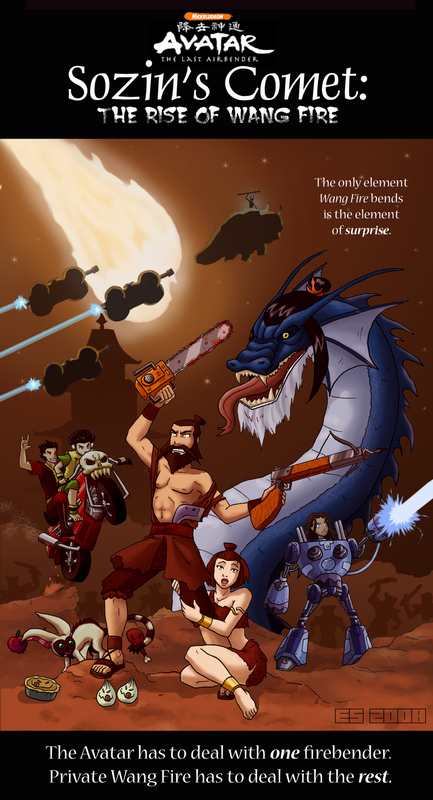
But I've always had a problem with Legend of Aang. A teeny, tiny little problem that I like to call "that bloody stupid ending". Because, while Avatar as a whole is a brilliant achievement, the four-part finale, Sozen's Comet, is a weak, scrappy, deus-ex-machina-ridden nightmare. Actually, no - that's not true. The Toph/Sokka/Suki section is suitably awesome, and the Zuko/Katara/Azula showdown is among the show's best ever parts. But Aang's story - the third corner of the triangle - collapses, and brings the whole finale down with it. For me, at least, Sozen's Comet is a failure.

Naturally, spoilers follow.

So what have I noticed in rewatching the series? Has something changed my mind?
No - quite the opposite. I've noticed something that crystallises what was already wrong with the ending. Something that makes the failure hurt even more.
It concerns the first episode of the second season; an episode called The Avatar State. The overall arc of season two - Earth - from the very beginning to the Empire Strikes Back ending ("If I leave now, I'll never complete my training - but I have to save my friends!") is all about the Avatar State. It's about Aang's fear, acceptance, attempts to control, and eventual loss of this glowing, superpowered god-state. One would think, after that entire season of setup, that the Avatar State would play into the finale in some way. Oh, it absolutely does - but not in a way that makes any narrative sense.

The first episode of season two is about an Earth Kingdom general who believes that, after his victory at the North Pole, Aang is more than ready to defeat Firelord Ozai. All they need to do, he argues, is get Aang to the Fire Nation and release the awesome power of the Avatar State. By the end of the episode it becomes apparent that Aang has no control over the Avatar State. It is an uncontrollable force of destruction - too chaotic and unpredictable to use. If Aang is to defeat Ozai, the episode tells us, he must master the two remaining elements (earth and fire) and beat the Firelord on his own terms. Which would seem a fair and noble message for the episode to have, if only any of that had actually been true.

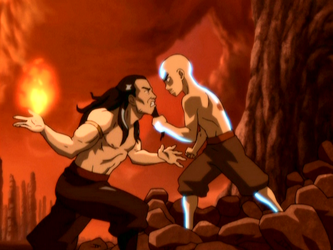
The reason that specific episode has spawned this blog post is that, in the finale, Aang defeats Ozai by... releasing the awesome power of the Avatar State. The general was right! Two seasons of the show, and countless lives within those seasons, could have been spared if they had just listened to that general!
All Aang's training; his mastery of all four elements; all the stuff that The Avatar State told us he would need to defeat the Firelord turns out to mean nothing. When they fight, Aang loses. He loses fast and he loses hard. At no point are they anything like an even match - Ozai decimates him from the very start.
Then Aang releases the Avatar State (an uncontrollable force of destruction that's too chaotic and unpredictable to use, don't forget) and the tables are instantly turned. Ozai runs away; Aang wins; hooray. Remind me again why this kid needed to spend two series learning earth and fire, please?

This could have played well if, and only if, Aang was in control of the Avatar State. If that glowy blue god had still been recognisably Aang, just more powerful, then I would have no complaints. That was, after all, the point he had supposedly reached at the end of season two. We never got to see him in control of it because Azula skewered him with lightning, but we saw him let go of his material attachments, we saw his chakras (everybody loves chakras) unblocked and flowing freely. As the guru explained, this should have given Aang complete control over the Avatar State.
Yet the thing that defeats the Firelord (so very very easily) is not Aang. It doesn't act like Aang (except in one fantastic moment involving a beard); it doesn't move like Aang; it doesn't fight like Aang (it barely "fights" at all). Then, when it is going to kill Ozai - something Aang has just spent three episodes telling everyone that he would never do - the only way Aang can prevent this is to actually come out of the Avatar State. That doesn't sound like control to me.

So now we find Aang once again facing Ozai as his own human self. Now, surely, he will use those bending skills he spent two seasons learning. This moment should justify all that training and hardship instead of just barging in blindly when the general suggested.
But no. Instead, Aang uses a fifth kind of bending (deus) that he learned literally that morning (ex) from a handy giant lion-turtle (machina). The show's greatest moment, this is not.

So, in conclusion, if Aang had listened to an overzealous general when he first reached the Earth Kingdom, the war would have been over roughly a day later. Two days at a stretch.
Aang spends two whole series learning how to bend earth and fire, mastering water, and learning to control the Avatar State. And not a single part of that comes into play during the show's eventual conclusion.
There's also the fact that the finale turns the credible villain of the Firelord into a caricature and a joke in the Phoenix King. But that's for another time.
For now, all that matters is that the general was right.

I love Avatar - but Sozen's Comet mainly just upsets me. Not least because, on top of everything else, it's clearly a meteor and not a comet.

Friday, 28 June 2013

A Different Superman Film

I was planning to post a link to this anyway, just to counteract all the recent Superman negativity on this blog, but I've just watched it again, and it's actually more relevant than ever in the wake of Man of Steel.

The "this" I'm talking about is Max Landis' demented seventeen-minute retelling of The Death and Return of Superman. It may seem like a weird antidote to my Superman complaints, because it's basically quarter of an hour of Landis (writer of Chronicle; son of John) complaining about Superman, but it's not really that at all - it's just pointing out how dumb comics actually are. Not Superman, not DC, just comics in general. They are all like this and, much as we may complain, it's a big part of why we love them.

What makes it even funnier, post-Man of Steel, is how much applies to what that film did. The Doomsday fight, for instance - "Punch face; lets see who goes harder until one of us passes out!" - perfectly sums up all the fights in Snyder's movie.
When Lois Lane asks the villain if he's Clark Kent, and the exasperated response is, "I just killed thirty-thousand people!" I actually burst out laughing. In Man of Steel, that death-count could absolutely still apply to Clark!
Also, just hearing The Death of Superman recounted brings back memories of Kevin Smith's horrible script for Burton's Superman Lives. Despite all the problems Man of Steel has, it could have been a lot worse.

You may not like the film, of course. It is very sweary (I advise my prudish brother JJ to skip it) and Landis is maybe a little smug and annoying (intentionally, and no worse than anyone else on the internet) but, if you can get past that, it's a great little celebration of the beautiful stupidity of superheroes.

Click here for The Death and Return of Superman. It's educational!

Sunday, 23 June 2013

Man of Steel, Script of Lead

The first draft of my review for Man of Punching was actually much longer than the version that I ended up posting. It originally went into detail about the numerous issues I had with the film's script. The screenplay is by David S. Goyer, one of the writers on the Batman films, and it's kind of terrible. Ultimately, I cut those sections out because, as well as getting way too long, the review was coming across as almost entirely negative, where my feelings are actually about half-and-half. The script issues are definite problems, but they aren't the problems that kept me from enjoying the movie, so the review worked fine without them.
I still feel they're worth discussing, though, and I have that first draft lying here unused, so lets use it to take a deeper look now. This post is quite long, and will get into a few story specifics, but the only real spoiler is clearly labelled and easily avoided. Let's do this.

The scene that best sums up everything wrong with this script is one at the end of the first act. Superman's father, Jor-El, explains to his son that, where other Kryptonians have their purpose and destiny chosen for them and imprinted upon them before birth, he, Superman, is free to choose a destiny for himself. Then Jor-El immediately follows this speech with, "So here is exactly what I've decided you must do with your life..." and hands him a suit to wear.
Putting aside the questions of what the suit is doing there (on a scout-ship from thousands of years ago that has nothing to do with the House of El) and why its colours don't match any others used by Krypton, this scene highlights three problems that are indicative of the entire film: a problem with exposition, a problem with setup and payoff, and a problem with convolution.


1: Exposition

The scene above is one where Jor-El just stands and talks at Clark (or Kal) about the plot. It goes on for quite a while, and Jor-El even has some Kryptonian PowerPoint slides prepared.
While there's nothing inherently wrong with this approach, everything he is explaining has already been dealt with, or at least touched on, earlier in the film. We've already seen how the caste system works, we already know that Kal-El was born naturally, we watched General Zod attempt a coup, and we saw Krypton explode. This was all established in the film's fifteen minute prologue on Krypton. It's fair to give us a refresher on this stuff, but there's no need to spell it all out in detail as though it's new information - otherwise, what's the point of showing that prologue in the first place?
That's not even the last time this stuff gets explained! Zod himself rehashes some of it when he first meets Supes, he later repeats it in a debate with Jor-El, and then, during the final battle, he finds time in his busy, punch-filled schedule to clearly lay out all his motivation - detailing the history of both his character and his people. Again.

It's a - if not the - basic rule of storytelling: show, don't tell.
No-one in a story should ever have to explain their motivation (except possibly in a mystery reveal) because we should be shown those motivations through their actions, inactions and interactions. It can even be done through costumes and props - think how much more effective it would be to just see a framed Pulitzer on Lois Lane's desk, rather than having her exclaim, "I'm a Pulitzer Prize-winning journalist!" to her own boss.

In a way, Man of Steel is actually very true to the early era of comics, when writers didn't trust the artists to convey meaning, so they filled every panel with a massive speech bubble of the hero saying out loud what they were doing or thinking.
This is never clearer than in the Krypton-set prologue. That part actually looks like a Golden Age sci-fi comic, too - all weird creatures, insane costumes and nonsense technology. I'm pretty sure there's Kirby Dots.
The writing in this sequence is as pulpy as the design. All anyone does is hurriedly explain the plot to each other, using unwieldy semi-classical language. Jor-El is in the middle of explaining Krypton's doomed fate to a council who keep explaining Krypton's history, when Zod bursts in and explains why he's starting a coup, prompting Jor-El to explain his history with Zod and all his thoughts on all of this. He then goes home and explains to his wife a plan they've no doubt been discussing for months. It's ridiculous but, because the four-winged dragons and the council's giant hats are also ridiculous, it isn't noticeably out of place. It's not until we get to Earth, and the film decides to act deadly serious, that this style of exposition-filled dialogue really starts to grate.

The Krypton stuff is actually some of the better exposition in the film because at least people are explaining things that we are actually seeing. It's not showing or telling - it's doing both. At its worst, Goyer's script doesn't even stretch that far, telling us - and expecting us to accept on faith - things that it never shows us for ourselves.

There's a scene in an IHoP (product placement!) where Superman faces Zod's sidekick Faora. They have an awesome, but way too short, fight, which Faora wins by being better at punching. Then she tells Supes that he can never win because he is held back by his morality, and her advantage is that she has none. Then she proceeds to beat him by being better at punching.
You would think, after (or maybe just before) telling him that, she would demonstrate her point by using his morality against him. Like, say, distracting him by threatening one of the many humans in the room. But no - she just punches him some more. This little speech is seemingly prompted by nothing - there's no reason for her to be saying that right now.
There's no reason for her to say it at any point, actually. We never see any evidence that Superman's morality is putting him at a disadvantage. We never see any evidence that Superman really has much morality anyway (see: carparks, petrol-stations, death). It comes up once much much later but, other than that, Faora's monologue is the only evidence the film gives us - it tells, but it never shows.

Jonathan Kent, Clark's father, has many similar monologues. He's one of the better characters in the film, but he gets the worst exposition by far. Every line he utters is a warning to his son that people are not ready to see his powers, that the world will fear him, and that no-one can be trusted. Kevin Costner makes this work somehow, but on the page it's just flat preachy statements from his first line to his last.
That's pretty terrible in itself, but what makes it far worse is that we never see any evidence to back him up. There's a woman whose son sees Clark using his powers, and she seems a bit worried or concerned, but hardly terrified. Yet Jonathan keeps telling his son, again and again, how careful he needs to be because people won't be able to handle it and will go for their pitchforks.
There's also a bit where Perry White won't print a story for the same reason, which made me giggle. He's a newspaper editor - that's exactly the kind of public reaction they usually aim for!
Both Perry and Jonathan are guilty of telling without showing. Nothing in the film suggests that people are afraid of Superman, yet we're expected to believe it because it's explained in dialogue. People do seem a little uncertain and twitchy around him, and the military do fire on him at one point - but that's because he's actively destroying a town, which is honestly fair enough. As it is, because Jonathan Kent keeps saying these things so fervently without anything else in the film backing him up, he just seems paranoid and crazy. He does some pretty messed up things based on this belief of his but, without seeing his fears confirmed, it's impossible for us to agree with his actions.
He's a nutjob, frankly. But he didn't need to be a nutjob. If we'd actually witnessed a violent, crazed reaction from someone who found out about Clark, we'd be on his dad's side without question. But we never do - we just hear about it from a man who hasn't witnessed it either. Jonathan is only a nutjob because Man of Steel relies too much on spoken exposition.

Again and again, this movie stops doing whatever it's doing so that it can tell us what it's doing. Worse, it often tells us what it's not doing instead of actually doing it. It's a problem.
At one point this excessive amount of exposition is actually what drives the plot! When Zod experiences super-hearing and vision for the first time, he is overwhelmed and disoriented by it. We know this because we already saw Clark go through it himself. Showing us was enough - we get it. But, just in case we don't get it, the script then has Superman explain to Zod exactly what he's experiencing, explain that he learnt how to deal with it as a child, then explain how he deals with it. Zod later uses this information to cope with the problem himself, allowing him to commit mass-murder.
As a general rule, if the exposition in your film directly leads to hundreds of deaths, your film probably has too much exposition.


2: Setup and Payoff

Jor-El, in that first scene above, is a total hypocrite. He goes on at length about Kal's freedom to choose his own fate, then straight-up tells him the fate (and clothes) that he's picked out for him.
The same thing happens with Jonathan Kent - he keeps telling Clark that he must choose if and when to reveal himself and then, in the same breath, outright telling him not to. When Clark actually does have to make that decision - when a certain important thing happens - Jonathan raises a hand, looks stern, and denies his son the very choice he kept lecturing him about. Also, shouldn't Martha, Clark's mother and Jonathan's wife, get some say in that moment? I'm amazed that she ever speaks to her son again.
Both Clark's adoptive and real father often pay lip service to the idea of "choice", yet both then continually dictate his actions. The only time he does make a choice, it's not the "what kind of man will you be?" that all the parental monologues have been setting up, but rather "will you hand yourself in to save the planet?" It's similar in some ways but, really, it's a very different question.
The setup here does not match the payoff. His parents set up certain choices, then make the choices for him, denying us a payoff. When we do get a decision-based payoff later on, it's to a decision which was never set up.

There are weird incongruities like this throughout Man of Steel. Wasted setups that don't really lead anywhere. When the film establishes Clark's super-senses (x-ray-vision, super-hearing), for instance, it's setting up an expectation that they will reappear. There is one gag about seeing through a mirror but, otherwise, he never uses these powers again. Why do we even see these skills if they never factor into the plot? Zod experiences them later, as mentioned above, but he gets over them so quickly (and also never uses them again) that their inclusion effectively serves no purpose, even then. They are set up, and then forgotten about. Again, no payoff. Which is a shame because they might have spiced up the repetitive action a bit.

Much more problematic are the unearned payoffs that the film fails to prepare us for. In the IHoP scene (again) it's established, through bad exposition, that Superman's weakness is his morality and compassion. Yet this weakness is never used against him until one specific point at the end. That one point is supposed to be the payoff to this morality setup, but it comes after we've watched Superman let carparks explode and buildings fall down and never once display any concern for the humans getting trampled underfoot. We've effectively forgotten Faora's speech by this point, because it was never reinforced by the action. So, while there is a payoff, it comes after an extended period of pointedly ignoring and contradicting the setup, which makes it feel like it comes out of nowhere.

Most damning of all, though, is another thing that comes out of nowhere, in the exact same scene at the end. A thing which is a massive spoiler, so skip ahead if you haven't seen it.

The conclusion of the final fight is so out-of-the-blue it's ridiculous.
We've been watching Kryptonians punch each other for over an hour now and at no point has there been any evidence that they can actually harm each other. No matter how many times they get punched through city-blocks or punched into space, they never bruise, they never cut, they never sprain or twist or fracture anything, and they never seem to get tired. Even their hair can't be damaged. There is never a single moment of setup - not one - to suggest that Kryptonians can hurt each other on Earth.
So, when Superman snaps Zod's neck, it's a complete shock. It is meant to be shocking, of course, but it's meant to be shocking because we don't expect Superman to kill people, not because we never knew it was even an option!
If the fight was going to end the way it did then we needed to be aware that Kryptonians can actually hurt each other (which would have made the endless punching more dramatic, too, because we might actually have felt some concern for the hero) and we needed more evidence that Superman is compassionate. As it stands, neither of these things are set up enough for the payoff to feel satisfying. It's a poorly handled ending to a poorly handled fight.

End of spoiler.

Many times, Man of Steel sets things up and doesn't pay them off, pays things off that it never sets up, and sets things up only to pay them off later, long after they've been actively contradicted. The disjointed feeling this causes is one of the film's biggest problems.


3: Convolution

Returning again to that first scene we mentioned, Kal-El was born naturally, where most Kryptonians are bred in Matrix-pods for a specific task. His DNA is natural and unaltered. That, Jor-El tells him, is why his destiny is a choice - he could become anything or anyone.
Zod wants to repopulate Krypton (or the Kryptonian species, at any rate), but he can't currently do it because he only has soldiers with him and their DNA is too limited. To complete his task he needs genetic templates for the other castes.
There is already a clear story emerging here. Zod needs a broader sample of DNA; Kal-El's DNA is malleable and undefined. If Zod gets hold of Kal, he will have pure Kryptonian DNA to work from.

That's it, surely. That's the story.
I'd be willing to bet a fair amount that, in an earlier draft of the script, that was the whole story. But, in the finished film, there's an entire extra layer of unnecessary complexity added onto it.

In the final script, Jor-El steals the Codex (a database containing the genetic templates for all Kryptonians) and somehow transfers that information into his son's cells. This essentially serves the same purpose as the scenario above - Zod needs Kal-El's DNA - but it's more complicated when it doesn't need to be.
It also raises a bunch of stupid questions. Why does Jor implant it into Kal, rather than just giving it to him? Why does he give it to Kal anyway? Allegedly it's so Kal can bring the species back at some point - but Jor continually says the race must start afresh, free of the caste system, where this Codex is the embodiment of that system. Why would he want to keep that? If he did want to keep it, why wouldn't he tell his son about it? And why the hell was it originally stored on the side of a broken skull?!
This stuff is ridiculous and, as we saw above, it could have been avoided easily while actually telling a simpler, neater story. In the movie Kal was born naturally, and Zod is hunting him for a different, unrelated reason. Wouldn't the film function better structurally and thematically if Zod was hunting him because he was born naturally?
It's convoluted and it's silly. And it doesn't stop there.

Zod and his micro-army attack Earth with a ship that's actually several ships that's actually a modified dimensional portal or something.
When the Kryptonians try to terraform the planet (technically "kryptoform", because "terra" means "Earth") they use a world-engine which is also a spaceship on one side of the planet, and a spaceship which is also a space-portal on the other side, which they then use to create a portal which links to the world-engine so that the portal-ship can also function as a world-engine. Maybe.
I've heard other explanations - all totally different - for exactly what is going on here. The point is that it's ridiculously complicated and it doesn't need to be. Why does the script not give Zod two world-engines? Or just use one? Having two gives Superman another thing to punch, I suppose, but why the portal stuff? There is a narrative reason, technically, but it's not one that can't be easily written around by using a slightly different narrative reason.

None of this stuff is necessary - it's convolution for the sake of convolution. And, for a film that loves to stop and explain things that are obvious, it skims over the needlessly confusing stuff without a second thought!


The more I think about it, the more terrible this script becomes. It ignores a whole list of basic storytelling rules, and expects us to swallow a lot of nonsense and bad dialogue instead.
What works in Man of Steel works because Cavill and Adams carry the film on much better performances than it deserved, and because, much as I am loath to admit it, Zack Snyder actually made a half-decent movie.
Looking back on his career so far, Watchmen notwithstanding (that one is entirely on him) it's a sequence of terrible scripts - Dawn of the Dead, 300, Sucker Punch - that he directed pretty damn well. Sucker Punch is a terrible script that he himself wrote, of course, but the direction's actually not bad.
If Snyder was given a decent script, without much depth and subtlety (he's not good at subtlety) - and if he could only find someone more imaginative to storyboard his action - then one day, one beautiful day, his films might actually be good!

But still not great.

Monday, 17 June 2013

Man of Steel Review

Hello. My name is Matthew, and I am a Michael Bay apologist.
Most people hate his films at this point but I still really kinda like them. I find a lot to love in Transformers 3 (which honestly isn't that bad) and I even enjoy Transformers 2 (which really is that bad and gets worse every time). Despite everything he does wrong - the lack of characterisation, the terrible and inappropriate humour, the rampant sexism - I've never understood the complaints about Bay's action scenes. The usual complaint is that those scenes look good, but are overlong, unengaging, and even boring; but I always find his action, dare I say it... awesome.
I bring this up not because Bay directed Man of Steel (he didn't), but because I finally understand how other people feel about his films. I felt the same during this one. The action in Man of Steel is spectacular - but that's all it is.

Superman (who only gets called that once, and everyone seems pretty embarrassed about it) can't be hurt. That's his thing. But that's murder to a compelling action scene - things bounce off him and he bounces off things and not once do we wonder if he'll be ok, because of course he will; he's Superman. It's true that you never really fear for the hero of any film - but at least in other films, you wonder how they'll win without dying, and the excitement comes from finding out. There's no wondering about it in this film - he's going to not die by being Superman, so it doesn't actually matter what happens to him.
Despite this, there are ways to make Superman compelling, action wise, and films in the past have pulled it off much better. Since the hero is never in any peril, put other characters in peril - less important characters who potentially could die - and have us worry whether Superman will manage to save them in time. The film does try this once - with Perry White and Jenny Olson (yes, you read that right) trapped in a collapsing street - but it falls flat because, although Supes does save them indirectly, he does so on literally the other side of the planet. He doesn't choose to save them or mean to save them, they just happen to be saved by what he does.
In fact, Superman barely saves anyone in Man of Steel. He saves Lois Lane a couple of times and he catches a falling guy at some point; but when main villain General Zod throws a petrol-tanker at his head, he ducks and lets it blow up a massive multi-story carpark. A carpark which we saw, just two shots ago, is full of people. Superman just lets them die and doesn't even glance back, and that's far from the only time it happens. His final fight with Zod levels buildings and flattens city blocks and, in that fight, the collateral damage must be enormous - thousands of people surely must get killed. That blood is as much on the hero's hands as the villain's, and that's a bit disturbing.

Going back to my Michael Bay comparison, I would say that Bay's action has a better sense of stakes in both of the ways I've mentioned. The heroes are not invincible and frequently get beaten up or killed (Dark of the Moon's best moment is when Bumblebee is about to be executed) and there are human characters that the robots do their best to save. But where the comparison really comes into play is in the variety of the action.
The action in Transformers includes fights with guns, fights with swords, fights with fists, one-on-one fights, one-against-many, many-against-many, fights in one place, fights on the move, fights to reach a target, fights to defend a target, and more. People find the action repetitive because it's all robots and explosions, but the circumstances - the objectives and events of those battles - are all different. In Man of Steel, by comparison, the aim of every single action scene is to break something (be it a doomsday weapon, a spaceship, or Zod's face) and Superman's approach to the problem is always the same: fly at it really fast and punch it really hard. If that doesn't work, he flies at it even faster and punches it even harder! Very occasionally he uses his heat-vision, but you can always be sure that, when his eyes stop glowing, his next move will involve flying. And punching.
Dealing with a squad of Zod's goons - flying fast and punching hard. With a Terraforming machine - flying, punching. Alien gunship - flying and punching! Zod himself - fly, punch, fly, punch, FLY, PUNCH. A lot of this flying and punching goes through buildings and stuff before it hits its target, which is a nice touch the first couple of times, but is wearing thin by the time Smallville has no buildings left. Then we go to Metropolis, where it happens all over again, but with bigger buildings.

There's one tiny scene - a minor beat in one of these huge action sequences - where Supes faces Zod's second-in-command in the wreckage of an IHoP. For a brief moment they have a pseudo-kung-fu fist-fight, where no-one flies through or gets thrown through anything. Some of the punches are blocked or dodged - and you suddenly realise that those are the first punches in the entire film that haven't connected. There's some finesse to this fight - it's tightly choreographed and it has rhythm. Then, as quick as it began, it's over again, and we're back to the flying. And the punching. That tiny scuffle really stood out to me as a great moment - just because it was something different.

The action in Man of Steel is unengaging, repetitive, and tedious - I actually blanked out during some of it and found myself daydreaming (there's a weird scene with robot-tentacles which was either really really short or I zoned out for most of it) which is something that's never happened to me before - but, with that unpleasantness out of the way, now we can talk about what the film does right. Because, believe it or not, I actually quite liked the first half of this movie!

My dark history with director Zack Snyder is well documented, but he does by far his best work here. All his films are great looking, and this one is no different - but this time the direction is steadier and he's finally developed some restraint against his worse impulses. There is slow-motion in Man of Steel, and there is fast-motion to show superpowers, but gone is the slow-fast-slow speed-ramping for which he is infamous. It is not missed.
He can't suppress his tonal problems, however, and there is an arthouse feel to a lot of it that feels out of place. Strange close-ups of buckets in the rain, or the wings of a moth, are followed up by blunt and obvious symbolim (Superman wonders if he should give himself up, backlit by a stained-glass window of Jesus at Gethsemane). It's all a bit confused, but the usually haphazard Snyder at least uses it to make specific points, which is definite progress.
More impressive, though, is that, for the first time ever, Snyder actually makes us care about the characters - though it's unclear how much of that is him and how much is down to the actors.

Amy Adams as Lois Lane is easily the best version of the character I've ever seen - and that's after only a few seconds on screen. She's still an investigative reporter, but here the emphasis is very much on investigative, as she actively chases stories, wrestles information out of people and won't take no for an answer. She still needs saving a few times, but only because she's such an active part of the story. She's brilliant - and she perfectly nails all the film's best lines.
Henry Cavill as Clark Kent and Kal-El (he's not even credited as Superman) is equally great as a subtly different version of the famous character. His Clark is an unformed entity at this point - he hasn't figured out his human self yet, because he hasn't figured out the rest - which is interesting in itself, but it's his Superman that really impresses. He's got an edge we've never seen before; friendly and polite, but at all times it is clear that he's dangerously in control of the situation, and almost everything he says can be interpreted as a subtle threat. He just casually breaks out of handcuffs at one point and quietly terrifies a room full of soldiers. I loved that about him, and I really wish we could have spent more time with this version of the character before the punching started.
The two leads have a really great relationship, too, that we've never seen before. Lois is someone Superman can confide in about his insecurities - she's the only one he can act human around, which is the opposite of the way this usually works. She's his only real friend, and that dynamic works perfectly for the characters... right up until they kiss. They never feel like a romantic couple, and that kiss feels like it's only there because it's expected to be there, not because it's earnt. It's weird. Other than that, though, they are the heart and soul of the movie.

Outside that central couple, the supporting cast do pretty well, but they're underserved by a script that constantly insists on leaden exposition - most of which either never pays off, or just restates the painfully obvious ("Either you die... or I do!" says Zod, helpfully explaining how fights work).
Russell Crowe's Jor-El, Superman's birth father, is swallowed by this and becomes Expositionman - especially in a stunted introduction where every line of dialogue is forcing setup down our throats, and later in an unnecessary scene where he recounts the exact same information all over again.
Kevin Costner's Jonathan Kent, Superman's adoptive father, fares much better. He fills the role with love and warmth, and a deep, aching sadness. He's probably the standout - leaving a lasting impression despite very little screentime, awful preachy dialogue, and some monumentally wrong-headed character decisions.
Lastly, Michael Shannon as General Zod has been getting a lot of attention and fanfare and, frankly, I don't see it. He's just shouty. The script gives him decent motivation but, like everything else, spells it out so obtusely - with Zod explaining himself again and again - that it just feels false. He's not bad by any stretch, but I really don't see what the fuss is about.

There's one other character that also deserves mentioning. The true star of the film, in the end, is Hans Zimmer's score. It's fantastically powerful and suitably epic, although it never actually blossoms into the triumphant version we heard in that one decent trailer.
Snyder has a reputation for essentially making music videos (see: Sucker Punch) but in the case of Man of Steel that becomes a strength, as his intense images complement that sweeping theme. However little I may have connected to the action on screen, the music frequently gave me goosebumps - it's a really great soundtrack and perhaps the best proof of this is that you never once feel the absence of John Williams.

So, I'm obviously sort of torn about Man of Steel overall. The first half, despite a very clumsy script, is bolstered by great performances into a fairly compelling and engaging character piece; but that's all quickly undone by the second half's endless sequence of things getting hit by flying things. Zack Snyder is primarily a stylist, and he's undoubtedly made a stylish film. He even manages to craft some interesting characters in the early stages but, come the second half, that's all forgotten in favour of shallow, repetitive visuals. Like all his films, the style overwhelms and obliterates any meaningful depth. It continues to look incredibly pretty but, beyond a certain point, just watching guys punch and fly through stuff again and again, with no variation, cannot get by on "pretty" alone. It is horribly dull.
I suppose I'd still recommend it, though? Maybe? You might have a different experience to me; I certainly seem to be in a minority among my friends, and most people are calling the action amazing. And that's fine - I'm glad they enjoyed it. But, to those people, I'd like to recommend that they check out the Transformers series. If this film honestly impressed them, then the imaginative variety of Michael Bay will surely blow their minds. Or possibly punch their minds. At high speed.

Thursday, 13 June 2013

Epic Review

I made a fuss and got quite excited when Wreck-It Wralph came out because, maybe for the first time, the big three animation studios had all, in the same year, put out great family films rather than just kids films. We're riding a wave of maturity and understanding that hasn't always been there in recent years. I wondered at the time if Blue Sky Studios, who haven't made a true family film since their first - the better-than-you-remember Ice Age - would continue this trend, since they seemed to be marketing Epic to an older audience than Robots, Rio, or the never-ending string of Ice Age sequels.
While not quite as mature or complex as the big three's films, I'm happy to report that there's more than enough depth to Epic to engage adults as well as kids. What I'm not happy to report is that no-one is actually treating it that way.

We saw Epic much later than we hoped or intended because all the local cinemas limited it to two showings a day (one in 2D, one in 3), and then almost immediately dropped down to just one because no-one was seeing it. Why was no-one seeing it? Because all the showings were at three and four o'clock in the afternoon! When we did finally see it, it was a weekend matinee on the last day of showing - a mere two weeks after release.
We've heard this song before: the same thing happened with Rise of the Guardians. That time it annoyed me, but now I'm just depressed. Maybe it's just that they both have pathetically generic titles, but it seems to go deeper than that - despite being accessible and entertaining to a wider audience than usual, these films got pushed into time-slots aimed solely at toddlers and young kids. Dreamworks and Blue Sky are taking risks - making more-original, less-juvenile, weightier films and stepping outside their Madagascar/Ice Age kid-friendly-franchise-milking model - and in return they get marginalised to a point where the films cannot and will not make money. The lesson they'll take from that is not to take these kinds of risks and to rely even more heavily on diluted sequels, while their interesting, risky projects get forgotten. Urgh - it's really bothered me, because both Guardians and Epic deserve better than that.

Epic itself is a deceptively simple film. It's a basic quest structure with all the standard beats you might expect, as the heroes and villains vie for control of a flower-pod MacGuffin. It centres around MK, a teenage girl with a very teenage name, moving in with her estranged father - an eccentric scientist who believes there are tiny people living in the woods. Naturally, she doesn't believe him until, naturally, she gets sucked down into an adventure both bigger and smaller than herself. The noble Leafmen of the forest must fight the orc-like forces of rot and decay; there's a stoic soldier, a rebellious outcast, a wise old man, a magical queen, and even a prophesy. It's all very familiar.
What sets Epic apart from its obvious comparisons is the nuance of the characters and relationships. Every character, including the villain, is deep and real, and they complement each other in surprising ways. Pretty much everyone in the movie has recently lost someone - a mother, a father, a lover, a son - and there are no fewer than three fractured father/child relationships. Incredibly, all of those are different enough, and handled well enough, that it never feels too contrived or melodramatic - it's underplayed but it still feels poignant. Even the comic-relief duo get a small emotional arc (well, one of them does) and, despite their potential to be incredibly annoying, these two have an odd-couple act that's actually kind of endearing.

As strong as the characters and relationships are, what really makes this all work is the visuals. This film is stupidly pretty. It's so pretty that it's almost distracting - it's easy to get lost in the images. There's a beautiful scene on a lilly pond, and an incredible memory sequence built out of swirling dust-motes, that are kind of breathtaking. The forest is wonderfully realised and alive, and the design-work - the Leafmen's grass armour and hummingbird saddles - is excellent. Even the battles (and there are many) are great-looking, with seas of evil Boggans exploding from the bark of trees and rotting through leaves and plants in a destructive wave, clashing with Leafmen in well-staged fights both in the air and on the ground. "Epic" is still a stupid title, but those fights genuinely earn it.
Oh, and the 3D's fantastic.

Epic may not do anything new, but what it does do it does very well. For all its familiarity, I really enjoyed seeing a simple story told well and presented so stunningly. I've just checked, and there actually are still a couple of midday showings this weekend, so you might even be able to enjoy it too! If you hurry. Maybe.

Monday, 10 June 2013

Brotherly Plug

I’ve mentioned my brother David a few times here - I’ve even linked to his blog, Hu’s Reviews, a few times - but I’ve never actually given him a full-on shout-out before. And he deserves a shout-out because, unlike me, he’s actually a qualified writer and knows what he’s talking about!
He just updated said blog with four new pieces but, since he’s too modest to advertise them himself, it falls to his girlfriend (who has a really interesting book-binding blog - yes folks, that was a plug within a plug) and me to advertise them for him.

The blog focuses on reviews, kinda like mine, but David started his first (making me the evil copycat, even though he has the beard) and his interests are more varied and adventurous than mine. I’m at home reviewing film and TV, and at a push I can maybe handle games, but David easily tackles all of those plus music and literature.
I’ve come to realise that I’m not very musical (my thoughts on music are usually no deeper than “I like it”, “I don’t like it”, and “are you sure this is music?”) so while his prog-rock pieces are always interesting and wonderfully enthusiastic, it’s the literary stuff I really like and really want to recommend. I wouldn’t know where to start reviewing a book, but he can break a novel down and see how it ticks in a way that makes me intensely jealous. He's not done many, but his review of Neil Gaiman’s American Gods, in particular, captures everything I felt about that frankly amazing book but couldn’t even begin to articulate.
My only complaints are that he doesn’t update often enough (though four posts in the last week go some way towards fixing that) and that, so far, he’s only focused on stuff he’s really liked. I’m all for positivity, but it would be nice to see him let loose and tear into something crappy - I know I enjoy doing it! Maybe I’ll talk him into reading Eragon...

Clearly I’m biased as hell, but I really do recommend checking out David’s blog and seeing for yourself. Give the guy enough traffic and maybe he’ll even get round to covering Game of Thrones!