Tuesday, 23 July 2013

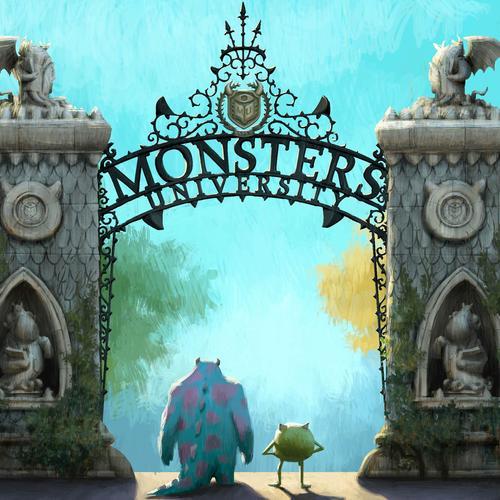
Monsters University Review

Depending on when you ask me - the day of the week, the alignment of the planets, and just how romantic I'm feeling - Monsters Inc. is either my favourite or my second-favourite Pixar film. But, even on the days when Wall-E is my favourite, the world of Monsters Inc. is still the most creative, unusual, vibrant and fun of all the worlds they've created. It's wildly imaginative in a way that really hasn't been topped.
It also has the most story potential by far. The Toy Stories all had to be about things that really happen to toys, Cars 2 had to be about things that really happen to cars, Finding Dory will have to be about things that really happen to fish, an Incredibles sequel would have to be about superheroics, another Ratatouille would have to be about cooking - but a Monsters film can be about anything at all, just with tail-holes in the chairs. If we're going to return to one of those worlds, I'm glad it's this one.

The only trouble is Boo.
The original Monsters Inc. hinges entirely on Sully's relationship with that tiny human stowaway. Their bond is so heartfelt and affecting that the film once made me cry my eyes out in a bar full of strangers because I caught the last few seconds with no sound on a tiny TV on the other side of the room. The film was playing on a loop so this happened three times.
If there's any reason not to make another Monsters film, it's this. There is no way - no possible way - they could continue the story of Sully and Boo without tarnishing Monsters Inc.'s perfect ending. Yet a sequel without that relationship would be just as bad. There's no way to win.
Being a prequel, then, allows Monsters University to spend more time in this fertile world, without affecting the emotional legacy of the original.

Without Boo, the problem then becomes finding heart and emotion somewhere else. Pixar's solution is, as ever, ingenious. The emotion in University comes from love and nostalgia for Monsters Inc. itself - not our own love and nostalgia, but Mike's.
As a small green child we see Mike visit the Monsters Inc. scare factory where, in wide-single-eyed wonder, he falls in love with the place - as we did, twelve years ago - and decides then and there to become the world's greatest scarer. Mike's adoration of Monsters Inc. is real and heartfelt, and so is this film's. We go back there a few times and, every time, it's an emotional highpoint for us and for the characters. It's those emotions that tie the film together, and that eventually lead Sully and Mike to the great friendship we know.

Driven by his childhood experience, we follow nerdy Mike to the prestigious Monsters University, to learn from the scariest monsters in the world. He quickly develops a rivalry with arrogant jock Sully, and that rivalry quickly gets them both thrown out of school. Their only hope is to learn to work together and help their misfit fraternity (what the hell is a fraternity, anyway?) to win MU's annual Scare Games, so that the Dean will have to reinstate them.
Yes, this is a pretty standard college-movie plot, and it hits every single beat and plot-point you'd expect - but the monster angle keeps things interesting enough, big enough, and unrelentingly funny enough, that it never suffers because of it. It all wraps up with exactly the college-movie ending you expect and... then it keeps going.
I won't say where it goes, exactly, but it's thoroughly unexpected and brilliant, as it slowly reveals that the film is not about what, or even who, you thought it was. It's pretty amazing.

It's admittedly not as resonant as Monsters Inc., but what University lacks in tears of sadness and joy, it makes up for in tears of laughter. This might be Pixar's funniest film. Every frame is packed with sight-gags and in-jokes and references, the script is very funny, and the physical humour is second-to none. Returning character "Randy" Boggs (who only has an evil squint because he doesn't wear his glasses) has a motivational poster on his wall that just destroyed me.
This stuff comes thick and fast - in fact the whole film is surprisingly fast-paced. Monsters Inc. took a while to let us settle into the crazy world before barraging us with jokes and action, but MU hits us with these from the very first scene. It doesn't let up, and it's great.

The one thing that isn't played for laughs, interestingly, is humans. In Inc. the monsters' fear of children was basically a joke - watching huge scary beasts freak out about a little girl (or a sock) - but where children are concerned, this film gets scary. The human world sections are like a horror film, dark and creepy, and any sight of a human is treated as terrifying and dangerous. It's a great, atmospheric approach and it leads to some of the film's best sequences.

All in all it's just a really solid movie. It has great set-pieces, tons of heart, and near constant hilarity. But the real strength comes from wonderful characters that we learn to love all over again, and a deceptively deep story that goes to truly surprising places. The last act pushes Monsters University from a fun extension of the first film into an actual worthy successor.
It won't be making me cry in any strange bars, thankfully, but it's fantastic all the same.

Friday, 19 July 2013

Gipsy Danger's iPod

Do you know what’s awesome about Pacific Rim? I mean, besides the eighty-metre-tall robot battle-suits, the hundred-metre-long alien death-monsters, and the fact that one hits the other in the face with a freaking boat! Apart from all that, d’you know what’s awesome?
The music is awesome.

It's by Ramin Djawadi, the guy who does the equally awesome music for Game of Thrones, and it's just perfect for this movie. The main theme makes me smile the exact same way the film makes me smile: it’s exciting, over-the-top, and just a little bit cheesy. The whole soundtrack is the same - there's an operatic horror-theme for the Kaiju, and an overly melodramatic one for the overly melodramatic bits. It knows it’s kind of silly, and it’s running with it - which is Pacific Rim in a nutshell. It's larger than life.

I said before that the Iron Man 3 score didn’t really feel like an Iron Man film to me. It's brilliant, but it's too choral and orchestral, where I think Tony Stark needs a more mechanical sound. Why I'm writing this post is that the main Pacific Rim theme - the one I linked to above - is exactly what I had in mind!
This film's also about guys in power-armour, and it turns out that Djawadi actually is the guy who did Iron Man, so I shouldn't really be surprised that they synch up so well. I just wanted to mention it because I thought it was interesting, and because it gives me an excuse to listen to it again.

Because it's awesome.

Wednesday, 17 July 2013

Pacific Rim Review

I live my life according to a strict and ancient code. It is called the Creed of MEGAS and, though it has many complex and subtle rules, its central and most sacred tenet is that I dig giant robots.
I can't help it. Something about them just speaks directly to the pleasure-centres of my brain, bypassing all conscious thought. If you show me a giant mechanical creature, I'll be willing to forgive any number of sins (cough, Revenge of the Fallen, cough). Big robots, and their piloted mech cousins, make me very very happy.

What this means is that Pacific Rim feels like it was made specifically for me, and I'm therefore the last person on Earth you should trust the opinion of.

For years the world has been under attack from Kaiju (Japanese for "giant sodding monsters") and, somehow, the best solution has turned out to be fighting them with giant sodding mech-warriors called Jaegers (German for "hunters" as well as "deadly student booze"). For a while this worked but now, with attacks becoming more frequent and more ferocious, the Jaeger Program is failing - their robots getting destroyed, their pilots getting killed, and their funding getting cut. The film follows retired mech-pilot Raleigh Becket and rookie Mako Mori - who operate his outdated Jaeger, Gipsy Danger, through a Vulcan mind-meld - as they prepare for a last-ditch assault on the deep-sea interdimensional portal from which the Kaiju emerge.

On some level, I'm completely aware how stupid all this is. But on another level, it's pretty much what my dreams look like.
Happily, Pacific Rim is also completely aware how stupid all this is. After the reveal of Gipsy Danger's secret weapon, and a ludicrous moment with a desk-toy (to say nothing of Ron Pearlman's black-market Kaiju-part-dealer), we're under no illusion that it’s taking itself seriously. This is a film with a character named Hercules Hansen, a building called the Shatterdome, and a part where someone actually shouts "Elbow Rocket!" Gritty and realistic, it is not.
Which isn't to say it's a parody, or even tongue-in-cheek. While it is self-aware, and often pretty silly, it's also incredibly earnest - even when it’s poking fun at itself, it's always completely invested in its story, its world and its characters.

In truth, those characters only range from simple archetypes to basic stereotypes. They’re reductive and minimal and their stories aren’t always handled as well as they could be, but they're humanised enough that we still care about their struggles. It’s used as shorthand: we recognise most of these characters immediately, which means we understand them immediately, too. The ones we don't understand are explained through the pilots' mind-melding process - "the Drift" - which means we literally walk through their minds and memories. This is criminally underused, but the few times it does appear are brilliantly effective and powerful.
In spite of their simplicity, or maybe because of it, the characters make a strong impression quickly and we can't help but care - so much so that Marshal Stacker Pentecost (played to perfection by Idris Elba) might be my favourite character of the year.
What sounds like a weakness is used as a strength - Pacific Rim is painting with broad strokes on a huge canvas, so it helps to keep things basic. The plot is simple, the characters are simple, their relationships are simple, and it's all delivered to the audience as simply and efficiently as possible. The entire history of the Kaiju War, for example, is recounted in the first five minutes, and it contains more information and world-building than most entire films!

The world-building is phenomenal, by the way. It's a living, breathing place, so real you can smell it. Those first five minutes - the origin of the Kaiju and Jaegers, the early victories and the later defeats - are so dense with information that they could almost be the first two films in a trilogy. In a film-climate currently obsessed with origins and franchises, it's actually surprising that they're not. This film is willing to just throw us into its world, fully formed and expertly realised, and to end without setting up a sequel. It's confident enough to be self-contained, and that's worth celebrating.

Also worth celebrating is the action. It's why I'm here, it's why you're here, and it's why director Guillermo Del Toro is here (though I still can't pronounce his name). They sold this film on robots fighting monsters, and it delivers spectacularly.
All the action is excellent. Inventive, distinctive, gorgeous to look at - everything you could want from this kind of mayhem. Del Toro clearly loves this stuff, and as much thought and care is put into the fight-scenes as into the dialogue scenes; maybe more. Every Jaeger, and every Kaiju, moves and fights in a different way, giving each battle a unique personality. The only constant is the scale and weight of these things - their movements are big and slow, and collisions and impacts feel enormous. We've seen big movie action before, but it's never felt this big.
Yet, even while the scope is huge, it remains tightly character-driven. We’re made aware early on just how vulnerable Jaeger pilots are, and the battles cut to them throughout. The pilots may shout things like "Let’s do this!" a little much, and it’s a shame that the character drama never directly informs the action, but it’s more than enough that we always know and feel the human stakes.

My only complaint is that the action peaks too early. The movie’s highlight is undoubtedly a battle in Hong Kong - it’s an incredible sequence for a number of reasons, not least the diversity and changing nature of the fight, but the main reason it works is that we can really see the scale of the combatants. When the Kaiju or Jaegers stand beside buildings, their size is breathtaking. When they’re smashing each other’s heads into those buildings, so much the better! It also means they can make use of their environment - using cranes or shipping crates as weapons - to further show off their enormous size and weight.
The final battle abandons urban locations for a more natural landscape - which makes sense for the story, and is certainly better for the population (Superman could learn a lot from these guys), but it means we lose the sense of scale. The fight itself is still fantastic and creative and tense, but it just can’t replicate the sheer awe of seeing how big they are. Of course, we know they’re still huge, but without a visual reference to remind us, they don’t really feel it.
It doesn’t matter, though, because that last fight is more about the characters. Though the drama may be thinly sketched and, dare I say, even a little cheesy, it all pays off in that climax. The battle may seem smaller, but it has a massive heart.

Pacific Rim is, first and foremost, enormous fun - pun intended. It takes a ridiculous premise and simple characters, and works them into a surprisingly effective story. That story is very basic, but it’s a solid enough foundation to build an immersive, believable world with some of the biggest, most impressive, most downright enjoyable action you could hope for. It's big, loud, crazy, over-the-top and completely lovable - which is not surprising since that's basically a discription of Del Toro.
I was probably going to love this film whatever happened. Just the mere sight of Striker Eureka (the shiny, sexy, super-high-tech Australian Jaeger) is enough to get me grinning like an idiot. But if you’re willing to accept how daft Pacific Rim can get - if you’re willing to Drift into its mindset - I think you’ll be grinning too.

Tuesday, 9 July 2013

Avatar: The Glory of Aang

In my last post I said that Avatar: The Last Airbender is one of the best animated series ever made; then I proceeded to rip it to pieces for its disappointing cop-out ending. I feel bad about that.
As I said, I love Avatar - but that's probably not the impression that last post gave. So, to restore balance to the Force (or possibly to the chakras), I'll be using this post to look at the things the show gets right.

If you were to ask me which is the best season of Avatar my default answer is, and always has been, Book Two: Earth. But now, watching it back for the umpteenth time, the second series seems to have a lot more fluff and filler than I remember. Stuff like that swamp episode, or the first three quarters of The Chase. Tales of Ba Sing Se is blatant filler of the most gratuitous order (though Sokka makes it work). Likewise Avatar Day (likewise Sokka). That's not even mentioning the entire subplot with Appa!

Book One has a lot less of this - or rather, if it does, it hides it better. There are filler episodes, but at that point we're still learning about Avatar's world, so even filler is interesting and new and educational. The only ones that really stand out as obvious fluff are The Great Divide and The Fortuneteller - but even those serve to teach us more about these characters we're still getting to know (and the latter gets a pass anyway on the strength of just one line).

Book Three is similar in that we've never visited the Fire Nation before that series. Again the filler episodes are teaching us about this new environment, and about the people living there. Up 'til now our only experience of the Fire Nation has been their military - faceless soldiers who do bad things. Episodes like The Painted Lady, or that weird Footloose one, show us that people in this land are just as oppressed as those in the Earth Kingdom - even while they're blatantly killing time before the real meat of the series begins.
Series three is also the first series to really embrace what Tales of Ba Sing Se tried to do, which is to just go crazy with it. The Play and the amazing anime beach episode (also, somehow, very important to the plot) are both half-an-hour of winking and nudging the audience - and Daydreams and Nightmares is just plain bonkers (did I mention that everybody loves chakras?).

So why do I prefer Book Two? As a series it's essentially treading water until Toph arrives in episode 6, and then it wastes even more time when we reach Ba Sing Se. Again, not even mentioning Appa's subplot. It has (discounting the finale) the deepest, and the longest, low-points of the entire show.
But it also has the highest high-points. Zuko Alone is one of the best episodes of the entire programme. The end of The Chase (after a pretty poor first half) is also brilliant. Zuko's entire second series arc, in fact, is one of the best things in the entire run - and it has that bit where Uncle sings.
Series two also introduces Toph, who is obviously amazing, and Azula, who is obviously terrifying. Azula's far more effective as both a character and a threat than either Ozai or Zhao (and infinitely better than Sparky-Sparky-Boom-Man) so this series has the best villain too.
But the real reason that Book Two is my favourite is how coherent it is as a complete series. The way that, from start to finish, it's always about the same few things, and how those same things all collide come the finale.

Think about the final battle of each series. In Book One, Team Avatar must save the North Pole from a Fire Nation attack - something that is only set up a few episodes earlier. There's also some business with two mystical koi fish and Sokka's new girlfriend, both of which are also introduced in the last few episodes. It ties in with a recurring theme of technology versus nature (and skepticism versus mysticism) that crops up throughout the first season, but that's about it. Don't misunderstand, though, this ending still works pretty damn well.
In Book Three, Team Avatar must stop the "Phoenix King"'s ridiculous plan to (literally) set the world on fire - something that's never ever mentioned before the finale itself! Also energybending and lion-turtles and Aang's unwillingness to kill (he's blown up a lot of ships and tanks at this point) are all clumsily introduced during the ending itself. It doesn't even have the thematic anchor of season one's ending. This ending does not work so well.
In Book Two, by contrast, Team Avatar must prevent the Fire Nation from conquering Ba Sing Se, capital city of the Earth Kingdom. This conflict is set up in the first episode of the series - maybe even before that, in season one. Everything else about that ending - the temptation of Zuko, Aang learning to let go, everything with the Dai Li - is set up and foreshadowed throughout the series. The only thing that feels out-of-nowhere is the sudden introduction of Guru Pathic - but we did already meet him briefly in Appa's Lost Days and, unlike energybending, the aid he provides is something Aang knew existed and has been searching for for some time.

Every episode (except, perhaps, that swamp one) pushes forwards these themes. Episodes I’ve already described as filler are nevertheless focused on the central concepts of the series. Both The Cave of Two Lovers and Return to Omashu, while not progressing the overall story very much, highlight Aang’s reliance on emotional attachments (to Katara and Bumi respectively) and the entire Appa plot, much as I keep joking about it, does the same thing. Almost losing Katara and actually losing Appa are the only things in the series that drive Aang into the uncontrolled Avatar State - and it’s no coincidence that they come at the beginning and exact midpoint of the series: the whole series is built around these ideas, so that the finale mirrors and contrasts what has come before.
Zuko’s arc is even more pronounced. The battle between what he wants and what he thinks he wants plays into every episode he appears in, and the string of choices and realisations he makes mean that his character is subtly different every time we see him - abandoning Uncle, accepting Uncle, dealing with Jet, dealing with Jin (his date), and finally helping Appa. Like Aang, this is underlined exactly half way through his arc by his screaming at the sky in Bitter Work. And, like Aang, the finale reflects and complements everything that has happened to him. It’s brilliantly done.
It’s not just those main two characters, either. Toph gets almost as much focus - her need to prove herself, and the insecurity it stems from, coming up again and again from her first episode to her last. The Chase and Tales of Ba Sing Se, again both mostly filler, highlight this, as do The Blind Bandit and The Serpent’s Pass. When she fails to save Appa in the desert (though not actually in The Desert) this gets hammered home to both us and her and, once again, it comes at the exact midpoint of the series.
Azula doesn’t have an arc the way the others do (though she does get the most interesting arc in Book Three) but her single-mindedness and skill at manipulation are emphasised from the minute we meet her, using Zuko’s desires against him. She does the same thing with Ty Lee, and later with the Dai Li, and, once again, the end of her story - the temptation of Zuko - mirrors where that story began.

This is all fantastically constructed, and perhaps the best thing the series then does with it is to split the characters up as the ending approaches - each character must deal with these issues alone before being thrown together to see how they affect one another. Even Katara and Sokka are separated to deal with her hatred of the Fire Nation and his desire to be a man - themes which, while not foreshadowed as overtly as Aang’s or Toph’s, have been bubbling under the surface for two whole series.
Then, after each character faces the conclusion of their individual theme and each seems to be heading towards a particular solution, the arcs suddenly come crashing together, veering off in new directions. Some get the catharsis they needed (“I am the greatest earthbender in the world!”) and others find it in a way they weren’t expecting (as with Sokka realising where he’s most needed), but it’s Aang and Zuko of course - their respective struggles reinforced so well throughout the season - who get the most interesting changes and turns in that ending. The whole thing eventually converges on Zuko - fitting, since his arc is the strongest in the entire programme - and comes together in unexpected, undesirable, but totally perfect ways.
Contrast this with series three, which splits up our characters, has them face their individual problems, then reunites them after the fact just to talk about what happened. It’s going for enormous scale, but the separate story threads feel quite small in the face of Book Two’s tightly interwoven character arcs.

The second series is just built so well, with every episode - filler, standalone or otherwise - driving towards an ending that must have been meticulously planned from the beginning. It escalates slowly and surely, focusing all the themes and character journeys towards that one unifying crescendo. It’s wonderful, honestly, and it’s one of the best seasons of television - certainly of a cartoon - I think I’ve ever seen. In terms of such an unblinking focus on the endgame, the only comparisons that come to mind are Babylon 5's fourth season, Doctor Who's fifth and, of course, the first series of Game of Thrones.
Book Two is the best example of this, but it’s a level of storytelling quality that’s consistent throughout the whole of all three seasons. The buildup and conclusion to Day of Black Sun in the third series, for example, is similarly great, and the worldbuilding in series one deserves a discussion all to itself. And that's all before we even mention the great dialogue, fantastic characters, stunning choreography, terrific animation (with hilarious inbetweens), and the way it can jump effortlessly from genuinely dark and serious stuff to ridiculous humour, doing justice to both!

It’s just an amazing show, basically, despite what I said last week. I love Avatar.

Thursday, 4 July 2013

Avatar: The Problem of Aang

My fiancée and I are watching through the Avatar cartoon again (a practice which is fast becoming an annual tradition) and I noticed something. It's something I've probably noticed before - but I've never had a blog before. So, because I'm loud and opinionated, I'm going to tell you about it.

Avatar: The Last Airbender (or Avatar: The Legend of Aang in countries where "bender" means something else) is one of the best animated series ever made. We all know this, so I won't dwell on it. If you haven't seen it - see it! The sequel series, The Legend of Korra is not quite as good (it's lacking in, for example, Sokka), but it's still better than almost anything else out there.
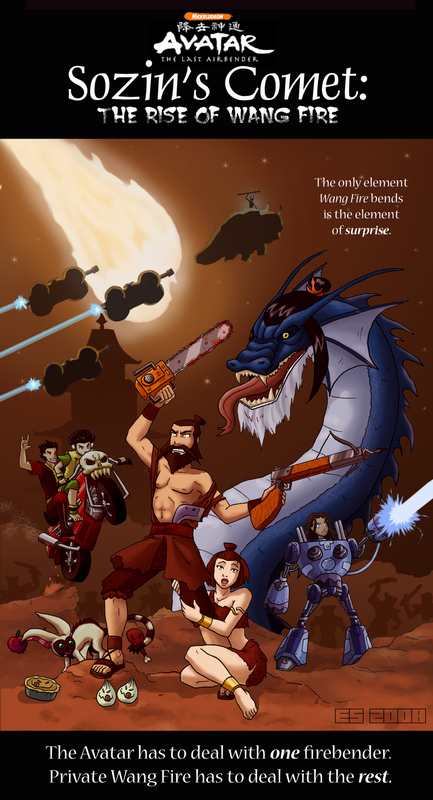
But I've always had a problem with Legend of Aang. A teeny, tiny little problem that I like to call "that bloody stupid ending". Because, while Avatar as a whole is a brilliant achievement, the four-part finale, Sozen's Comet, is a weak, scrappy, deus-ex-machina-ridden nightmare. Actually, no - that's not true. The Toph/Sokka/Suki section is suitably awesome, and the Zuko/Katara/Azula showdown is among the show's best ever parts. But Aang's story - the third corner of the triangle - collapses, and brings the whole finale down with it. For me, at least, Sozen's Comet is a failure.

Naturally, spoilers follow.

So what have I noticed in rewatching the series? Has something changed my mind?
No - quite the opposite. I've noticed something that crystallises what was already wrong with the ending. Something that makes the failure hurt even more.
It concerns the first episode of the second season; an episode called The Avatar State. The overall arc of season two - Earth - from the very beginning to the Empire Strikes Back ending ("If I leave now, I'll never complete my training - but I have to save my friends!") is all about the Avatar State. It's about Aang's fear, acceptance, attempts to control, and eventual loss of this glowing, superpowered god-state. One would think, after that entire season of setup, that the Avatar State would play into the finale in some way. Oh, it absolutely does - but not in a way that makes any narrative sense.

The first episode of season two is about an Earth Kingdom general who believes that, after his victory at the North Pole, Aang is more than ready to defeat Firelord Ozai. All they need to do, he argues, is get Aang to the Fire Nation and release the awesome power of the Avatar State. By the end of the episode it becomes apparent that Aang has no control over the Avatar State. It is an uncontrollable force of destruction - too chaotic and unpredictable to use. If Aang is to defeat Ozai, the episode tells us, he must master the two remaining elements (earth and fire) and beat the Firelord on his own terms. Which would seem a fair and noble message for the episode to have, if only any of that had actually been true.

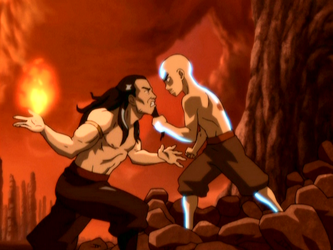
The reason that specific episode has spawned this blog post is that, in the finale, Aang defeats Ozai by... releasing the awesome power of the Avatar State. The general was right! Two seasons of the show, and countless lives within those seasons, could have been spared if they had just listened to that general!
All Aang's training; his mastery of all four elements; all the stuff that The Avatar State told us he would need to defeat the Firelord turns out to mean nothing. When they fight, Aang loses. He loses fast and he loses hard. At no point are they anything like an even match - Ozai decimates him from the very start.
Then Aang releases the Avatar State (an uncontrollable force of destruction that's too chaotic and unpredictable to use, don't forget) and the tables are instantly turned. Ozai runs away; Aang wins; hooray. Remind me again why this kid needed to spend two series learning earth and fire, please?

This could have played well if, and only if, Aang was in control of the Avatar State. If that glowy blue god had still been recognisably Aang, just more powerful, then I would have no complaints. That was, after all, the point he had supposedly reached at the end of season two. We never got to see him in control of it because Azula skewered him with lightning, but we saw him let go of his material attachments, we saw his chakras (everybody loves chakras) unblocked and flowing freely. As the guru explained, this should have given Aang complete control over the Avatar State.
Yet the thing that defeats the Firelord (so very very easily) is not Aang. It doesn't act like Aang (except in one fantastic moment involving a beard); it doesn't move like Aang; it doesn't fight like Aang (it barely "fights" at all). Then, when it is going to kill Ozai - something Aang has just spent three episodes telling everyone that he would never do - the only way Aang can prevent this is to actually come out of the Avatar State. That doesn't sound like control to me.

So now we find Aang once again facing Ozai as his own human self. Now, surely, he will use those bending skills he spent two seasons learning. This moment should justify all that training and hardship instead of just barging in blindly when the general suggested.
But no. Instead, Aang uses a fifth kind of bending (deus) that he learned literally that morning (ex) from a handy giant lion-turtle (machina). The show's greatest moment, this is not.

So, in conclusion, if Aang had listened to an overzealous general when he first reached the Earth Kingdom, the war would have been over roughly a day later. Two days at a stretch.
Aang spends two whole series learning how to bend earth and fire, mastering water, and learning to control the Avatar State. And not a single part of that comes into play during the show's eventual conclusion.
There's also the fact that the finale turns the credible villain of the Firelord into a caricature and a joke in the Phoenix King. But that's for another time.
For now, all that matters is that the general was right.

I love Avatar - but Sozen's Comet mainly just upsets me. Not least because, on top of everything else, it's clearly a meteor and not a comet.

Friday, 28 June 2013

A Different Superman Film

I was planning to post a link to this anyway, just to counteract all the recent Superman negativity on this blog, but I've just watched it again, and it's actually more relevant than ever in the wake of Man of Steel.

The "this" I'm talking about is Max Landis' demented seventeen-minute retelling of The Death and Return of Superman. It may seem like a weird antidote to my Superman complaints, because it's basically quarter of an hour of Landis (writer of Chronicle; son of John) complaining about Superman, but it's not really that at all - it's just pointing out how dumb comics actually are. Not Superman, not DC, just comics in general. They are all like this and, much as we may complain, it's a big part of why we love them.

What makes it even funnier, post-Man of Steel, is how much applies to what that film did. The Doomsday fight, for instance - "Punch face; lets see who goes harder until one of us passes out!" - perfectly sums up all the fights in Snyder's movie.
When Lois Lane asks the villain if he's Clark Kent, and the exasperated response is, "I just killed thirty-thousand people!" I actually burst out laughing. In Man of Steel, that death-count could absolutely still apply to Clark!
Also, just hearing The Death of Superman recounted brings back memories of Kevin Smith's horrible script for Burton's Superman Lives. Despite all the problems Man of Steel has, it could have been a lot worse.

You may not like the film, of course. It is very sweary (I advise my prudish brother JJ to skip it) and Landis is maybe a little smug and annoying (intentionally, and no worse than anyone else on the internet) but, if you can get past that, it's a great little celebration of the beautiful stupidity of superheroes.

Click here for The Death and Return of Superman. It's educational!

Sunday, 23 June 2013

Man of Steel, Script of Lead

The first draft of my review for Man of Punching was actually much longer than the version that I ended up posting. It originally went into detail about the numerous issues I had with the film's script. The screenplay is by David S. Goyer, one of the writers on the Batman films, and it's kind of terrible. Ultimately, I cut those sections out because, as well as getting way too long, the review was coming across as almost entirely negative, where my feelings are actually about half-and-half. The script issues are definite problems, but they aren't the problems that kept me from enjoying the movie, so the review worked fine without them.
I still feel they're worth discussing, though, and I have that first draft lying here unused, so lets use it to take a deeper look now. This post is quite long, and will get into a few story specifics, but the only real spoiler is clearly labelled and easily avoided. Let's do this.

The scene that best sums up everything wrong with this script is one at the end of the first act. Superman's father, Jor-El, explains to his son that, where other Kryptonians have their purpose and destiny chosen for them and imprinted upon them before birth, he, Superman, is free to choose a destiny for himself. Then Jor-El immediately follows this speech with, "So here is exactly what I've decided you must do with your life..." and hands him a suit to wear.
Putting aside the questions of what the suit is doing there (on a scout-ship from thousands of years ago that has nothing to do with the House of El) and why its colours don't match any others used by Krypton, this scene highlights three problems that are indicative of the entire film: a problem with exposition, a problem with setup and payoff, and a problem with convolution.


1: Exposition

The scene above is one where Jor-El just stands and talks at Clark (or Kal) about the plot. It goes on for quite a while, and Jor-El even has some Kryptonian PowerPoint slides prepared.
While there's nothing inherently wrong with this approach, everything he is explaining has already been dealt with, or at least touched on, earlier in the film. We've already seen how the caste system works, we already know that Kal-El was born naturally, we watched General Zod attempt a coup, and we saw Krypton explode. This was all established in the film's fifteen minute prologue on Krypton. It's fair to give us a refresher on this stuff, but there's no need to spell it all out in detail as though it's new information - otherwise, what's the point of showing that prologue in the first place?
That's not even the last time this stuff gets explained! Zod himself rehashes some of it when he first meets Supes, he later repeats it in a debate with Jor-El, and then, during the final battle, he finds time in his busy, punch-filled schedule to clearly lay out all his motivation - detailing the history of both his character and his people. Again.

It's a - if not the - basic rule of storytelling: show, don't tell.
No-one in a story should ever have to explain their motivation (except possibly in a mystery reveal) because we should be shown those motivations through their actions, inactions and interactions. It can even be done through costumes and props - think how much more effective it would be to just see a framed Pulitzer on Lois Lane's desk, rather than having her exclaim, "I'm a Pulitzer Prize-winning journalist!" to her own boss.

In a way, Man of Steel is actually very true to the early era of comics, when writers didn't trust the artists to convey meaning, so they filled every panel with a massive speech bubble of the hero saying out loud what they were doing or thinking.
This is never clearer than in the Krypton-set prologue. That part actually looks like a Golden Age sci-fi comic, too - all weird creatures, insane costumes and nonsense technology. I'm pretty sure there's Kirby Dots.
The writing in this sequence is as pulpy as the design. All anyone does is hurriedly explain the plot to each other, using unwieldy semi-classical language. Jor-El is in the middle of explaining Krypton's doomed fate to a council who keep explaining Krypton's history, when Zod bursts in and explains why he's starting a coup, prompting Jor-El to explain his history with Zod and all his thoughts on all of this. He then goes home and explains to his wife a plan they've no doubt been discussing for months. It's ridiculous but, because the four-winged dragons and the council's giant hats are also ridiculous, it isn't noticeably out of place. It's not until we get to Earth, and the film decides to act deadly serious, that this style of exposition-filled dialogue really starts to grate.

The Krypton stuff is actually some of the better exposition in the film because at least people are explaining things that we are actually seeing. It's not showing or telling - it's doing both. At its worst, Goyer's script doesn't even stretch that far, telling us - and expecting us to accept on faith - things that it never shows us for ourselves.

There's a scene in an IHoP (product placement!) where Superman faces Zod's sidekick Faora. They have an awesome, but way too short, fight, which Faora wins by being better at punching. Then she tells Supes that he can never win because he is held back by his morality, and her advantage is that she has none. Then she proceeds to beat him by being better at punching.
You would think, after (or maybe just before) telling him that, she would demonstrate her point by using his morality against him. Like, say, distracting him by threatening one of the many humans in the room. But no - she just punches him some more. This little speech is seemingly prompted by nothing - there's no reason for her to be saying that right now.
There's no reason for her to say it at any point, actually. We never see any evidence that Superman's morality is putting him at a disadvantage. We never see any evidence that Superman really has much morality anyway (see: carparks, petrol-stations, death). It comes up once much much later but, other than that, Faora's monologue is the only evidence the film gives us - it tells, but it never shows.

Jonathan Kent, Clark's father, has many similar monologues. He's one of the better characters in the film, but he gets the worst exposition by far. Every line he utters is a warning to his son that people are not ready to see his powers, that the world will fear him, and that no-one can be trusted. Kevin Costner makes this work somehow, but on the page it's just flat preachy statements from his first line to his last.
That's pretty terrible in itself, but what makes it far worse is that we never see any evidence to back him up. There's a woman whose son sees Clark using his powers, and she seems a bit worried or concerned, but hardly terrified. Yet Jonathan keeps telling his son, again and again, how careful he needs to be because people won't be able to handle it and will go for their pitchforks.
There's also a bit where Perry White won't print a story for the same reason, which made me giggle. He's a newspaper editor - that's exactly the kind of public reaction they usually aim for!
Both Perry and Jonathan are guilty of telling without showing. Nothing in the film suggests that people are afraid of Superman, yet we're expected to believe it because it's explained in dialogue. People do seem a little uncertain and twitchy around him, and the military do fire on him at one point - but that's because he's actively destroying a town, which is honestly fair enough. As it is, because Jonathan Kent keeps saying these things so fervently without anything else in the film backing him up, he just seems paranoid and crazy. He does some pretty messed up things based on this belief of his but, without seeing his fears confirmed, it's impossible for us to agree with his actions.
He's a nutjob, frankly. But he didn't need to be a nutjob. If we'd actually witnessed a violent, crazed reaction from someone who found out about Clark, we'd be on his dad's side without question. But we never do - we just hear about it from a man who hasn't witnessed it either. Jonathan is only a nutjob because Man of Steel relies too much on spoken exposition.

Again and again, this movie stops doing whatever it's doing so that it can tell us what it's doing. Worse, it often tells us what it's not doing instead of actually doing it. It's a problem.
At one point this excessive amount of exposition is actually what drives the plot! When Zod experiences super-hearing and vision for the first time, he is overwhelmed and disoriented by it. We know this because we already saw Clark go through it himself. Showing us was enough - we get it. But, just in case we don't get it, the script then has Superman explain to Zod exactly what he's experiencing, explain that he learnt how to deal with it as a child, then explain how he deals with it. Zod later uses this information to cope with the problem himself, allowing him to commit mass-murder.
As a general rule, if the exposition in your film directly leads to hundreds of deaths, your film probably has too much exposition.


2: Setup and Payoff

Jor-El, in that first scene above, is a total hypocrite. He goes on at length about Kal's freedom to choose his own fate, then straight-up tells him the fate (and clothes) that he's picked out for him.
The same thing happens with Jonathan Kent - he keeps telling Clark that he must choose if and when to reveal himself and then, in the same breath, outright telling him not to. When Clark actually does have to make that decision - when a certain important thing happens - Jonathan raises a hand, looks stern, and denies his son the very choice he kept lecturing him about. Also, shouldn't Martha, Clark's mother and Jonathan's wife, get some say in that moment? I'm amazed that she ever speaks to her son again.
Both Clark's adoptive and real father often pay lip service to the idea of "choice", yet both then continually dictate his actions. The only time he does make a choice, it's not the "what kind of man will you be?" that all the parental monologues have been setting up, but rather "will you hand yourself in to save the planet?" It's similar in some ways but, really, it's a very different question.
The setup here does not match the payoff. His parents set up certain choices, then make the choices for him, denying us a payoff. When we do get a decision-based payoff later on, it's to a decision which was never set up.

There are weird incongruities like this throughout Man of Steel. Wasted setups that don't really lead anywhere. When the film establishes Clark's super-senses (x-ray-vision, super-hearing), for instance, it's setting up an expectation that they will reappear. There is one gag about seeing through a mirror but, otherwise, he never uses these powers again. Why do we even see these skills if they never factor into the plot? Zod experiences them later, as mentioned above, but he gets over them so quickly (and also never uses them again) that their inclusion effectively serves no purpose, even then. They are set up, and then forgotten about. Again, no payoff. Which is a shame because they might have spiced up the repetitive action a bit.

Much more problematic are the unearned payoffs that the film fails to prepare us for. In the IHoP scene (again) it's established, through bad exposition, that Superman's weakness is his morality and compassion. Yet this weakness is never used against him until one specific point at the end. That one point is supposed to be the payoff to this morality setup, but it comes after we've watched Superman let carparks explode and buildings fall down and never once display any concern for the humans getting trampled underfoot. We've effectively forgotten Faora's speech by this point, because it was never reinforced by the action. So, while there is a payoff, it comes after an extended period of pointedly ignoring and contradicting the setup, which makes it feel like it comes out of nowhere.

Most damning of all, though, is another thing that comes out of nowhere, in the exact same scene at the end. A thing which is a massive spoiler, so skip ahead if you haven't seen it.

The conclusion of the final fight is so out-of-the-blue it's ridiculous.
We've been watching Kryptonians punch each other for over an hour now and at no point has there been any evidence that they can actually harm each other. No matter how many times they get punched through city-blocks or punched into space, they never bruise, they never cut, they never sprain or twist or fracture anything, and they never seem to get tired. Even their hair can't be damaged. There is never a single moment of setup - not one - to suggest that Kryptonians can hurt each other on Earth.
So, when Superman snaps Zod's neck, it's a complete shock. It is meant to be shocking, of course, but it's meant to be shocking because we don't expect Superman to kill people, not because we never knew it was even an option!
If the fight was going to end the way it did then we needed to be aware that Kryptonians can actually hurt each other (which would have made the endless punching more dramatic, too, because we might actually have felt some concern for the hero) and we needed more evidence that Superman is compassionate. As it stands, neither of these things are set up enough for the payoff to feel satisfying. It's a poorly handled ending to a poorly handled fight.

End of spoiler.

Many times, Man of Steel sets things up and doesn't pay them off, pays things off that it never sets up, and sets things up only to pay them off later, long after they've been actively contradicted. The disjointed feeling this causes is one of the film's biggest problems.


3: Convolution

Returning again to that first scene we mentioned, Kal-El was born naturally, where most Kryptonians are bred in Matrix-pods for a specific task. His DNA is natural and unaltered. That, Jor-El tells him, is why his destiny is a choice - he could become anything or anyone.
Zod wants to repopulate Krypton (or the Kryptonian species, at any rate), but he can't currently do it because he only has soldiers with him and their DNA is too limited. To complete his task he needs genetic templates for the other castes.
There is already a clear story emerging here. Zod needs a broader sample of DNA; Kal-El's DNA is malleable and undefined. If Zod gets hold of Kal, he will have pure Kryptonian DNA to work from.

That's it, surely. That's the story.
I'd be willing to bet a fair amount that, in an earlier draft of the script, that was the whole story. But, in the finished film, there's an entire extra layer of unnecessary complexity added onto it.

In the final script, Jor-El steals the Codex (a database containing the genetic templates for all Kryptonians) and somehow transfers that information into his son's cells. This essentially serves the same purpose as the scenario above - Zod needs Kal-El's DNA - but it's more complicated when it doesn't need to be.
It also raises a bunch of stupid questions. Why does Jor implant it into Kal, rather than just giving it to him? Why does he give it to Kal anyway? Allegedly it's so Kal can bring the species back at some point - but Jor continually says the race must start afresh, free of the caste system, where this Codex is the embodiment of that system. Why would he want to keep that? If he did want to keep it, why wouldn't he tell his son about it? And why the hell was it originally stored on the side of a broken skull?!
This stuff is ridiculous and, as we saw above, it could have been avoided easily while actually telling a simpler, neater story. In the movie Kal was born naturally, and Zod is hunting him for a different, unrelated reason. Wouldn't the film function better structurally and thematically if Zod was hunting him because he was born naturally?
It's convoluted and it's silly. And it doesn't stop there.

Zod and his micro-army attack Earth with a ship that's actually several ships that's actually a modified dimensional portal or something.
When the Kryptonians try to terraform the planet (technically "kryptoform", because "terra" means "Earth") they use a world-engine which is also a spaceship on one side of the planet, and a spaceship which is also a space-portal on the other side, which they then use to create a portal which links to the world-engine so that the portal-ship can also function as a world-engine. Maybe.
I've heard other explanations - all totally different - for exactly what is going on here. The point is that it's ridiculously complicated and it doesn't need to be. Why does the script not give Zod two world-engines? Or just use one? Having two gives Superman another thing to punch, I suppose, but why the portal stuff? There is a narrative reason, technically, but it's not one that can't be easily written around by using a slightly different narrative reason.

None of this stuff is necessary - it's convolution for the sake of convolution. And, for a film that loves to stop and explain things that are obvious, it skims over the needlessly confusing stuff without a second thought!


The more I think about it, the more terrible this script becomes. It ignores a whole list of basic storytelling rules, and expects us to swallow a lot of nonsense and bad dialogue instead.
What works in Man of Steel works because Cavill and Adams carry the film on much better performances than it deserved, and because, much as I am loath to admit it, Zack Snyder actually made a half-decent movie.
Looking back on his career so far, Watchmen notwithstanding (that one is entirely on him) it's a sequence of terrible scripts - Dawn of the Dead, 300, Sucker Punch - that he directed pretty damn well. Sucker Punch is a terrible script that he himself wrote, of course, but the direction's actually not bad.
If Snyder was given a decent script, without much depth and subtlety (he's not good at subtlety) - and if he could only find someone more imaginative to storyboard his action - then one day, one beautiful day, his films might actually be good!

But still not great.